
Driving the Mani, end to end
Two and a half hours of road, a week of reasons to stop
The Mani is the middle finger of the Peloponnese, and the road that runs down it is the most honest way to read the place. Two and a half hours from Kardamyli to Cape Tainaro if you don’t stop, which is the wrong way to do it. Patrick Leigh Fermor, who settled near Kalamitsi and watched the peninsula change for forty years, wrote that every rock and stream is a myth. He was right about the rocks. The streams mostly went dry in the 1970s.
What follows is a field-note survey — what we stop for, what we drive past, where we’d send a friend with a week and a rental car.
Start in Kardamyli, but don’t stay too long
Kardamyli is where writers settle and where the road into the Mani properly begins. The old village above the new one — Old Kardamyli, signposted off the main road — is a ten-minute walk of tower-houses and a small Byzantine church, and it does the job of orientation: this is what the architecture looks like, this is the colour of the stone, this is the relationship between village and mountain. From the harbour at Agios Nikolaos, three kilometres south, the fishing boats are still working boats.
The pebble beaches just south — Ritsa, Kalogria, Foneas, Delphinia — are the swim stops. Foneas is the one with the rock arch and the deep water; Kalogria is the one the families pick. We’d take Foneas over the others for a quick stop on the drive south, simply because the water drops away fast and you can swim properly in twenty minutes without wading.
The honest note: Kardamyli in July and August is busier than it pretends to be. Spring and autumn are the seasons the village was built for. In high summer, leave by 9am if you’re heading south — the road narrows past Stoupa and the campervans start to matter.
Every rock and stream is a myth.
Walk the Viros Gorge before the day gets hot
The Viros Gorge cuts inland from Kardamyli into the Taygetos, and the trail through it follows what locals call the royal road — the old paved track that connected the Mani to Sparta over the mountains. It is a three-to-five-hour walk depending on how far up you go, mostly under shade of plane and oak, with Byzantine chapels and abandoned stone houses at intervals. The grooves on the larger stones are where the mule trains wore them down.
Go early. The gorge holds heat by midday in June through September, and the last hour of climbing out is exposed. Take more water than you think you need — the streams Fermor wrote about are mostly seasonal now, and what runs in March is dry by July. Strong shoes, not trainers; the limestone is slick where the goats have polished it.
The Mani over the Lousios Gorge in Arcadia for walkers who want the same time-depth with the sea ten minutes away at the end. The Lousios is greener; the Viros is harder-edged and more characteristic of the country you’re driving through.
Limeni and Areopoli — the working middle
Past Stoupa the coast hardens and the road climbs over a headland before dropping into Limeni. The water in the small bay there is the colour the brochures lie about — a flat, shallow emerald that genuinely looks unreal at midday. Eat by the water; sleep up the hill in Areopoli, which is the village you base in if you want the towers, the small kafenia, and a working plateia in the evenings.
Areopoli is the Mani’s capital in the old sense — the place the revolution started in 1821, the place the bishops still come to. The boutique shops on the main square sell ceramics and honey at the prices you’d expect, and one or two of them are good. The kafenia behind the church are better. Order the siglino — cured pork kept in olive oil, sliced thin, eaten with bread and the local cheese — and the lalaggia, the twisted fried dough that turns up at every village feast.
Limeni for lunch, Areopoli to sleep, is the pattern. Doing it the other way round means driving the headland twice in the dark, which is doable but not enjoyable.
Diros, and a word on the underworld
The Diros Caves are eight kilometres south of Areopoli, and they are the one organised attraction on the peninsula. A guide takes you through thirty to forty minutes of underground river by small boat, then a short walk out. The stalactites are genuinely worth the trip; the queue in August is not. The ancients believed the caves were one of the entrances to Hades, which feels about right when the boat cuts the engine and the only sound is water dripping off rock thirty metres above your head.
Go first thing in the morning or in the last hour before closing. The middle of the day is a coach-tour crush, and the cave is not large. Bring a layer — it is consistently cool inside regardless of the heat outside, which is welcome in July and noticeable in March.
This is the only stop on the drive where we’d actively advise against the obvious season. Diros in shoulder season, off-peak hours, is one of the better hours you can spend in Greece. Diros in August at 2pm is a queue with a cave attached.
The deep south — Gerolimenas, Vatheia, Tainaro
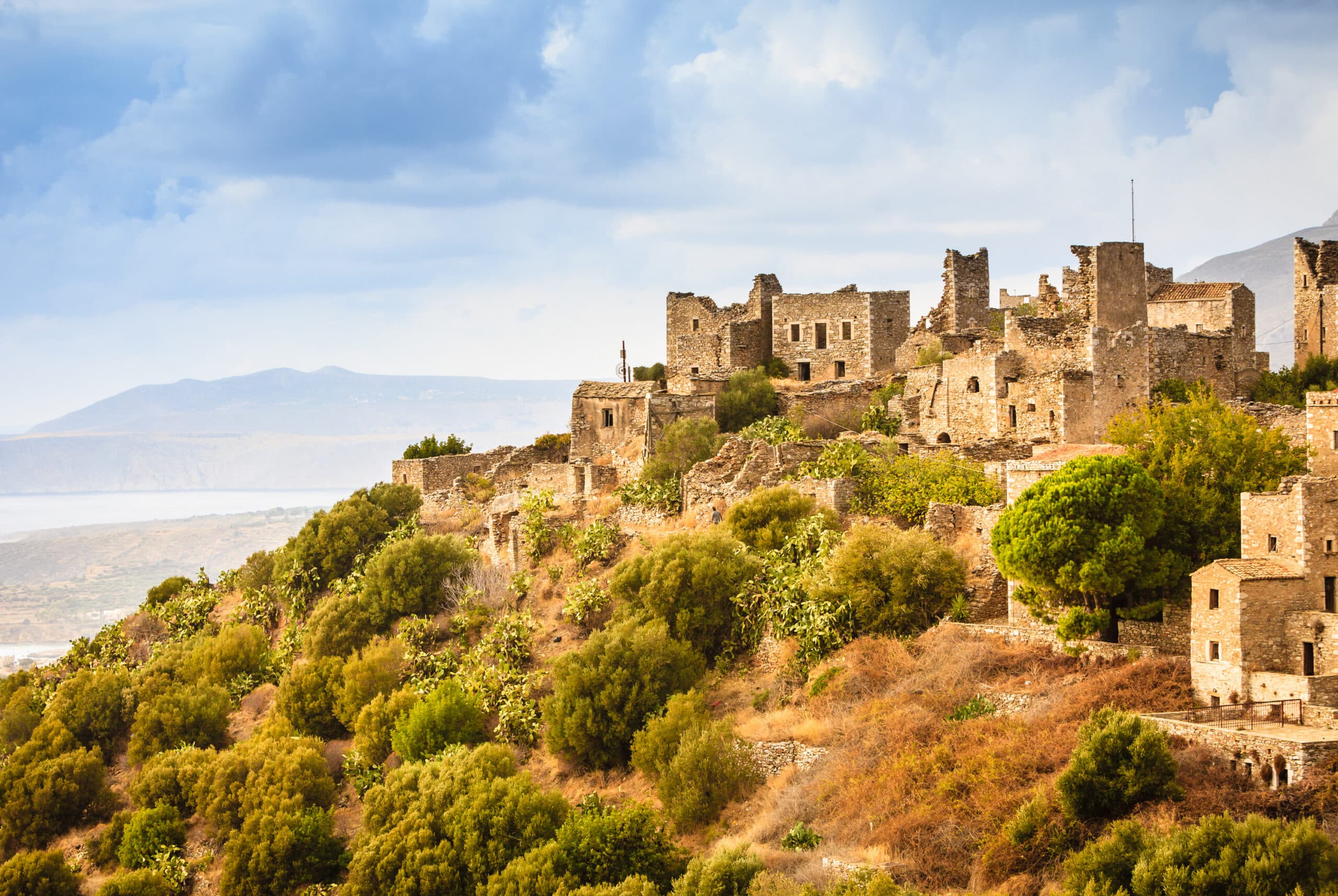
South of Areopoli the country changes again. The olives thin out, the stone takes over, and the villages get smaller and more fortified. Gerolimenas is a small stone harbour with two or three places to eat fish straight off the boat — a good lunch stop. Vatheia, ten minutes inland, is the tower-village every photograph of the Mani is taken in. Most of its towers are abandoned, a few are being restored. Walk it in the late afternoon when the light is on the stone and the heat has gone out of the day.
The road ends at Cape Tainaro. The lighthouse hike from the car park is forty minutes each way over rough ground; wear proper shoes. The cape is often described as the southernmost point of mainland Europe — Punta de Tarifa in Spain has a competing claim, depending on how you count peninsulas. Either way, it is the southernmost point of the Mani, which is the point that matters when you’re standing on it. The swim at the small cove below the path is colder than you expect and worth the walk down.
What we’d skip, what we’d add
Skip the inland detours to Saidona, Pyrgos, and Kastania unless you have a particular interest in church frescoes or are staying a week — they are beautiful and they are also forty minutes of switchbacks each way. Skip Mezapos and Katafigi as separate stops; you can see both from the road without parking.
Add a half-day kayak from Kardamyli at the start of the trip. The coast between Kardamyli and Stoupa has two sea caves and a handful of coves only reachable by water, and seeing the peninsula from the sea before you drive its length changes how you read the rest. Morning over afternoon — the wind in the Messinian Gulf builds after eleven, and the swim stops are colder than they look from the boat. Children from about five upwards can sit in the front of a double; younger than that and the day gets long for them.
Add an olive oil tasting on the way back north. The Mani koroneiki — the small Messinian olive — is the variety the oil here is built on, and an hour with a producer who can walk you through the difference between this year’s pressing and last year’s is the cheapest education in Greek food you’ll get. Most of the family groves are organic in practice if not always in certification.