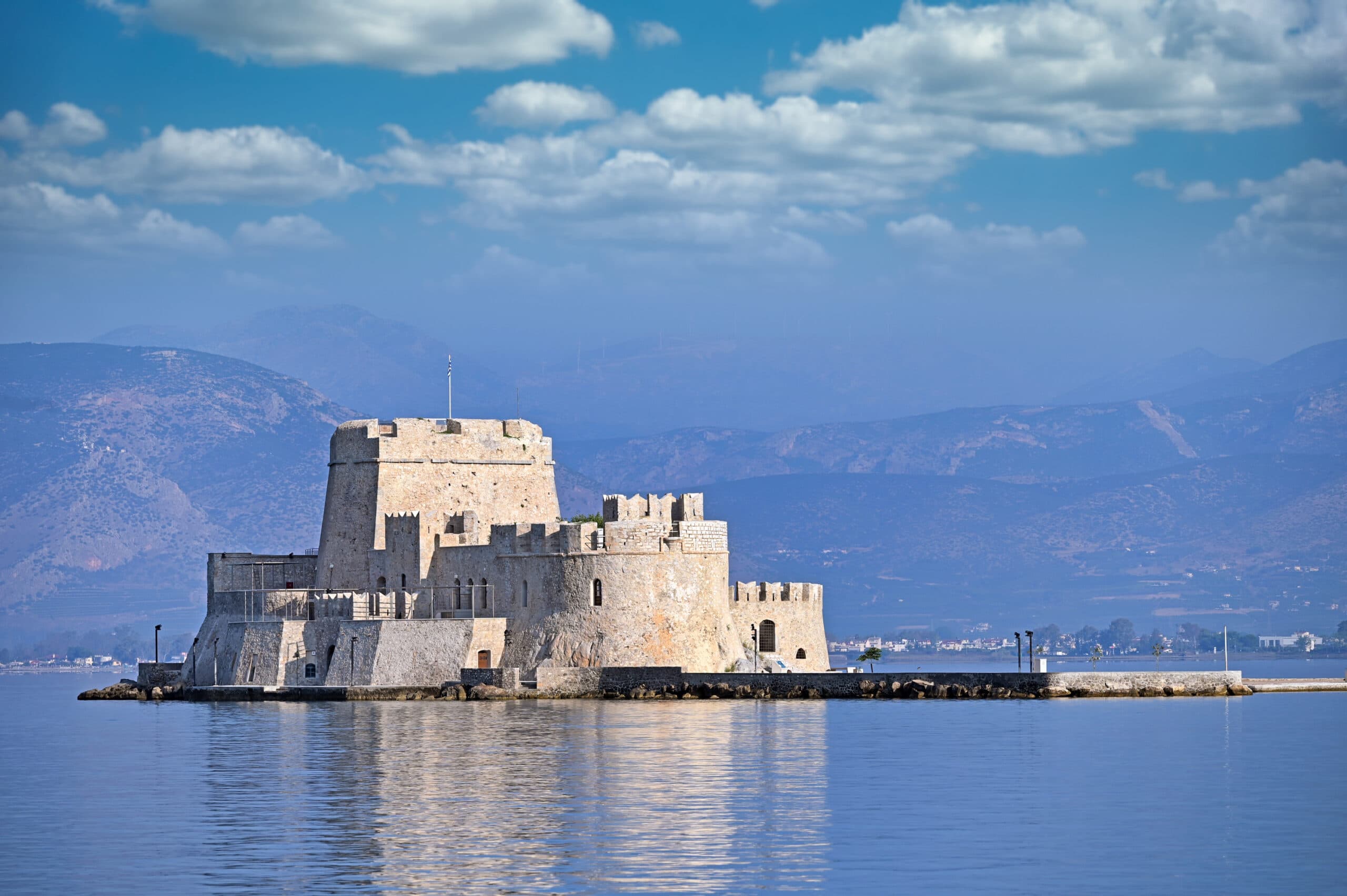
Greece’s first modern capital, surrounded by its oldest places. A Venetian harbour, the Lion Gate of Mycenae, an open-air theatre that still works after 2,300 years.
Argolida is the small fertile prefecture at the northeastern corner of the Peloponnese — a triangle of farmland, citrus groves and low hills wrapped around the Argolic gulf, with Nafplio at its heart and three world-monuments in the surrounding fields.
The plain itself is some of the oldest farmed land in Europe — the Bronze-Age civilisation that built Mycenae and Tiryns grew its grain here. Nafplio sits on a promontory at the gulf head, with three fortresses (Palamidi, Akronafplia, Bourtzi) and a long Venetian-Ottoman main square. Forty minutes east, the theatre of Epidaurus hosts a summer festival in the original 4th-century BC stone. The eastern peninsula climbs toward the climbing village of Leonidio and the lemon-grove coast around Porto Heli.
Hover the map or the list — they're linked. Numbered roughly the way you'd drive them.
A pair of quiet bays on the road to Epidaurus — fishing villages, vineyard tavernas, the warm shallow water of the inner Argolic gulf.
The oldest continuously-inhabited town in Europe — a working agricultural city with a Mycenaean acropolis above and a Roman theatre cut into the hill.
A red-rock town under a 700-metre cliff on the eastern Parnonas — fifteen hundred sport-climbing routes, an aubergine festival, and a Tsakonian dialect older than modern Greek.
A deep-water bay on the eastern Argolic coast — a small town wrapped around a sailing harbour, with the lemon groves of Kranidi behind and Spetses ten minutes off.
A long sandy beach in a sheltered bay just south of Nafplio — family hotels, fish tavernas, small islands you can swim out to. The summer beach for Argolida.
The healing sanctuary of Asklepios and the perfect 4th-century theatre still in use every summer. Acoustics so clean a coin dropped on stage is heard in the back row.
The Bronze-Age citadel of Agamemnon — the Lion Gate, the shaft graves, the cyclopean walls. The wellspring of Greek myth, in open Argolida light.
Greece’s first modern capital and the prettiest old town in the Peloponnese — marble lanes, three fortresses, a Venetian fortlet on an islet in the harbour.
Three trips through Greece's first capital and the oldest places around it.
Mycenae and Epidaurus at their quietest. Citrus blossom in the Argolic plain. Sea still cold but Nafplio quaysides full of cafe sun.
Best month for Leonidio climbing and the Argolida hills. Sea reaches 22°C by mid-June. The Epidaurus festival programme begins late June.
Hot and busy in Nafplio old town; the Argolic coast and Tolo beach in full season. Friday and Saturday performances at Epidaurus most weeks.
Sea still 24°C in September. October opens the orange harvest in the Argolic plain; Mycenae golden in afternoon light.
Citrus harvest in the plain. Nafplio is a winter weekend town for Athenians; the coast and climbing villages largely close. Mycenae empty and astonishing.
For five years (1829–1834) Nafplio was the capital of the newly independent Greek state. Its first governor, Ioannis Kapodistrias, was assassinated on the steps of Saint Spyridon — the bullet hole is still in the wall. The old town is the architecture of that moment: Venetian houses re-roofed in tile, neoclassical mansions with shutters in nine colours, a long marble main square that is still the social hinge of the eastern Peloponnese.
Argolida holds the densest cluster of Bronze-Age sites in mainland Europe. Mycenae is the citadel of Agamemnon — the Lion Gate, the shaft graves of Schliemann, the great tholos tomb known as the Treasury of Atreus. Tiryns, ten minutes from Nafplio, is its denser, more fortified cousin: cyclopean walls so massive Pausanias compared them to the pyramids. Both stand in open farmland, with no town overlay; the Bronze Age in the Argolic plain is mostly sky and stone.
The theatre of Epidaurus, built into the slope of Mount Kynortion in the 4th century BC, holds 14,000 people in fifty-five rows of stone. Its acoustic is the best-known wonder of Greek engineering: a coin dropped on the orchestra stone is audible in the top row. Each summer, the Athens & Epidaurus Festival programmes Aeschylus, Sophocles, Euripides and Aristophanes in their original spaces — you sit on the same stone the original audiences sat on.
Argolic cooking is the cooking of a fertile plain and a sheltered gulf: orange, olive, artichoke, fish from the inner bay. Nafplio is the most considered restaurant town in the Peloponnese; the surrounding countryside is humbler and just as good.
A century-old phyllo-and-custard pastry made by the Roidi family in Nafplio old town. The breakfast queue down Stilianou Lampropoulou street is part of the experience.
The Argolic plain is the densest citrus-growing region in Greece. Valencia and Maltese oranges from January to April; juice on every cafe table. The blossom in March is unforgettable.
Small sweet shrimp from the inner Argolic gulf, cooked in tomato, ouzo and feta. The signature plate of the Tolo and Kandia tavernas.
The Nemea valley behind Argos produces Agiorgitiko — medium-bodied, supple, distinctly Peloponnesian. The flagship grape of the Saint George wine region, on every Nafplio wine list.
The long thin pale-purple aubergine of Leonidio, with its own PDO and an annual August festival. Stuffed, grilled, or candied as a sweet preserve.
Whole young walnuts in heavy syrup — the spoon-sweet of an Argolic afternoon, served on a tiny plate with a glass of cold water and a coffee.
What to expect in each — Nafplio & Argolida has a more idiosyncratic set of stays than most places in Greece.
Twenty-odd properties built into Venetian and neoclassical houses on the marble lanes. Stone vaulted rooms, roof terraces over the harbour, no cars in the lanes.
Restored stone farmhouses on citrus and olive estates around Mycenae and the Argolic plain. Half a dozen rooms, breakfast from the garden, working presses in autumn.
Small properties on the eastern Argolida coast (Porto Heli, Kranidi) with private beaches and harbour access. The discreet end of Greek summer.
Stone-built rooms in Leonidio and the surrounding villages. Five or six rooms, a wood stove in winter, climbing crags walkable from the door.
Most travellers fly into Athens (ATH) and drive 1½–2 hours via the new motorway. Nafplio is the closest serious base in the Peloponnese to Athens — ideal as the first or last stop on a longer Peloponnese loop.
A car is helpful but Nafplio itself is walkable. Mycenae 25 min, Tiryns 10 min, Epidaurus 40 min. The eastern Argolic coast (Porto Heli) is 1½ hours by road or by water-taxi; Leonidio is 1½ hours south.
May–June and September–October. The summer festival at Epidaurus runs July–August. Nafplio works year-round, including winter weekends.
Walking shoes for Palamidi (999 steps) and the Mycenae citadel. A light jacket for theatre evenings at Epidaurus — the stone is cold after sundown. Swim shoes for the rocky east-coast coves.
Nafplio old-town hotels book up two months out for May, September and October. Epidaurus theatre seats are released in early May for the summer programme; the best seats go in the first week.
Tell us a little about the trip you want — pace, who's coming, how you'd like to spend your mornings. We'll build the days.