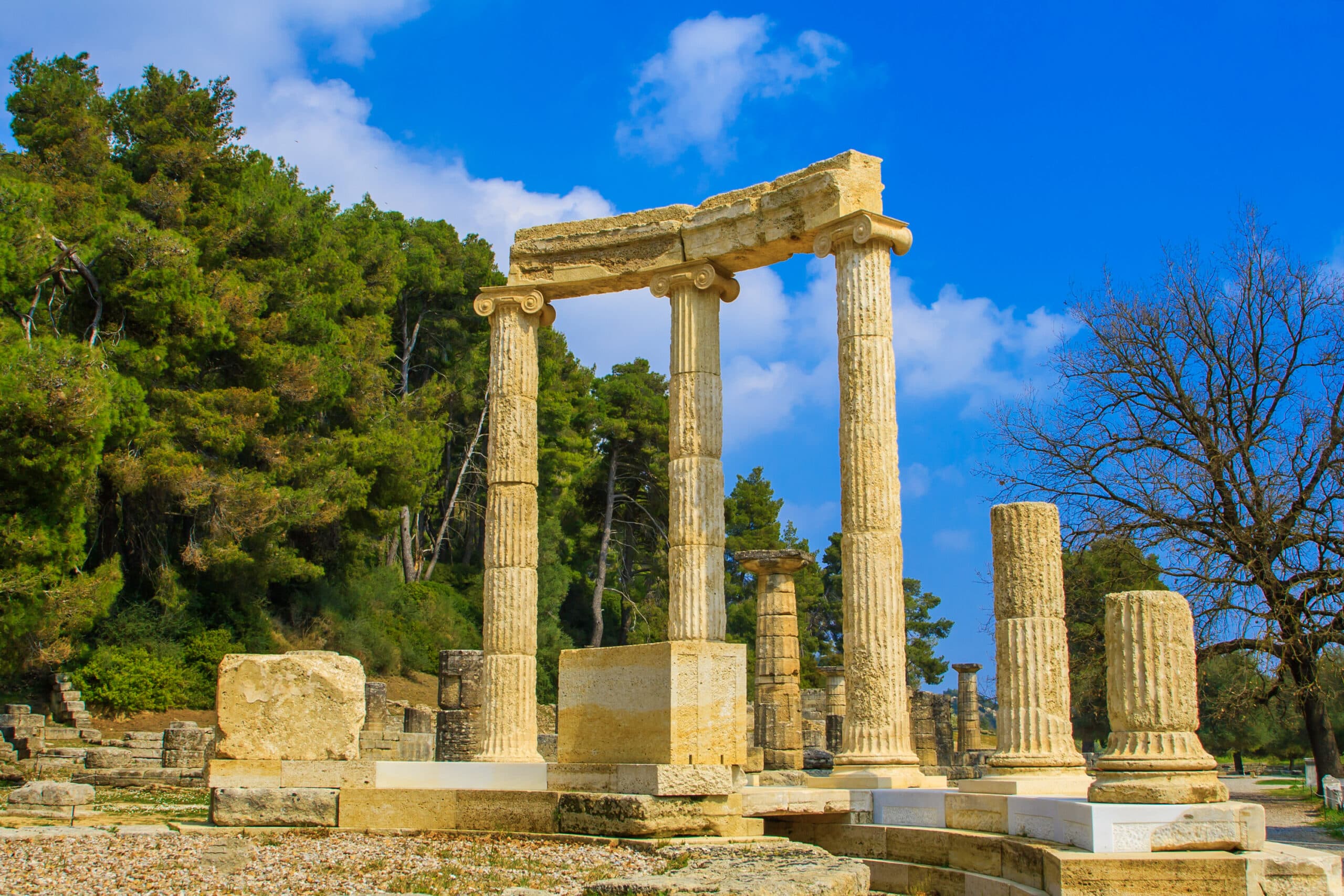
Where the Games began. Olympia at the centre, the Odontotos cog railway climbing into the firs, the hidden vineyards of the Kalavryta–Helmos slopes, the great Foloi oak forest and the long ridge of Mount Erymanthos.
The west of the Peloponnese is the prefecture of Ileia and the southern slopes of Achaia — long sandy coast at the bottom, oak forest in the middle, two great mountain ranges (Erymanthos and Helmos) at the top, and Ancient Olympia sitting in a quiet river valley between them all.
Most travellers come for Olympia alone and miss the country it sits in. Behind the sanctuary, the road climbs through the Foloi oak forest — 33 km² of rare deciduous oak, the oldest in Europe — and on into the slopes of Mount Erymanthos, where Hercules once hunted the boar. North-east, in Achaia, the Odontotos cog railway climbs the Vouraikos gorge to Kalavryta, and the slopes of Mount Helmos hold a small ski resort and a cluster of hidden, high-altitude wineries at 800–1,100 metres growing crisp whites and old-vine reds. We treat all of it as one trip.
Hover the map or the list — they're linked. Numbered roughly the way you'd drive them.
A small fishing-and-cruise port half an hour from Olympia, with the long sandy beaches of Kourouta and Skafidia north and south. The soft coastal coda to the inland days.
A nine-kilometre sand beach backed by an umbrella-pine forest and the Strofylia wetland — the longest natural beach in the Peloponnese, lightly developed, with the cleanest summer water in the prefecture.
The 2,355-metre limestone ridge that closes the western Peloponnese — fir-forested slopes, traditional villages on its skirts, and the legendary cave where Hercules took the Erymanthian boar.
A 33-square-kilometre plateau of rare deciduous Vallonea oak at 700 metres above Olympia — the oldest oak forest in Europe, walked on quiet marked paths from the village of Foloi.
A 1,700–2,340-metre ski station on the southern shoulder of Mount Helmos — small, family-run, with proper alpine winters Dec–March and trail running, mountain biking and high cool-air walks all summer.
A cluster of six small estates on the north slopes of Helmos at 800–1,100 metres — cool-climate Chardonnay, the rare red Mavro Calavrytino, Mavrodaphne. Almost no-one outside the area knows them; tastings by appointment.
A 750-metre stone town in a basin below Mount Helmos — the terminus of the Odontotos, the gateway to the Helmos snow resort, and the most considered base for the hidden wineries on the north slope.
The 22-kilometre rack-and-pinion railway from Diakopto on the Corinthian gulf, climbing the Vouraikos gorge to Kalavryta — four open carriages, three tunnels, an hour each way, the most beautiful train in Greece.
The sanctuary of Zeus, the workshop of Pheidias, the original Olympic stadium and the museum holding the Hermes of Praxiteles — walked in a slow morning, with a long lunch in the modern village.
The oak forest carpets in cyclamen and orchids; the Vouraikos gorge runs at full force; Olympia has its best afternoon light. Helmos still has snow above 1,500m.
Long days, the Erymanthos paths dry, the Foloi forest in full leaf, Olympia in early-summer light. Beaches at Kalogria reach swimming temperature by mid-June.
Olympia and the lowlands hot; the answer is altitude. Helmos and Erymanthos comfortable in the high twenties at 1,000m; Kalogria the swimming day.
The Helmos wineries pick from mid-September — cool-climate Chardonnay first, the reds in October. The Foloi oak turns gold; our favourite month for the prefecture.
Snow on Helmos and Erymanthos, the ski resort open Dec–March, Kalavryta a winter weekend town. Olympia at its quietest — our preferred month for the sanctuary is November.
The sanctuary at Olympia is one of the most complete ancient sites in Greece — the Temple of Zeus, the workshop where Pheidias carved the chryselephantine statue of Zeus (one of the seven wonders of the ancient world), the Heraion, the Bouleuterion, the original Olympic stadium with the marble start-line still in place. The Games ran here continuously from 776 BC to AD 393, every four years for 1,170 years — the longest-running cultural institution in Western history. The site’s museum holds the Hermes of Praxiteles and the Nike of Paeonios; both alone justify the trip.
The Odontotos — “the toothed one” — is a 22-kilometre rack-and-pinion railway built by Italian engineers in 1896, climbing from sea-level at Diakopto on the Corinthian gulf to 750 metres at Kalavryta. It runs through the deep Vouraikos gorge on a single metre-gauge track, crossing six bridges, three tunnels and a precipitous central rack section where the third toothed rail engages. Two open carriages, an hour each way; you can also walk one direction — the gorge path is good for half a day. It is the most beautiful train ride in Greece, and one of the best in Europe.
On the north slopes of Mount Helmos, between 800 and 1,100 metres, a cluster of six small estates farms cool-climate vineyards almost no-one outside the prefecture has heard of. The whites — Chardonnay, Roditis, Lagorthi — are crisp and stony, more like the Jura than the Mediterranean. The reds are the surprise: Mavrodaphne grown for dry wine rather than the famous sweet, and Mavro Calavrytino, a near-extinct local red the estates have brought back from a handful of old vines. Tastings are quiet, by appointment, in working cellars; the estates are 10–20 minutes apart on slow mountain roads from Kalavryta.
Above Olympia the road climbs onto a 700-metre plateau covered by the Foloi oak forest — 33 square kilometres of rare Vallonea oak, the largest deciduous oak forest left in Europe, designated a Natura 2000 site. Behind it rises Mount Erymanthos, 2,355 metres of limestone, fir and traditional villages — the wildest, least-visited mountain in the Peloponnese, the place where Hercules captured the Erymanthian boar. There are good marked paths through the oak (start at Foloi village) and a serious ridge walk on Erymanthos with a guide. Both feel a long way from any Greece you have seen before.
The cooking of the western Peloponnese moves between three altitudes — long coastal lunches of grilled fish on the Ionian, slow Olympia–valley pork and wild greens, and a serious mountain table at Kalavryta with local lamb, hard cheese and the hidden wines. The bread is good everywhere.
A near-extinct red grape rescued by the small estates of the Helmos slopes — dark, peppery, low yield, a wine you will only meet in Kalavryta and a couple of Athens lists. Worth the trip on its own.
A lightly salted, air-dried pork cut from the inland villages around Olympia and Foloi, served sliced thin with hard cheese as a pre-lunch meze. The local answer to lardo.
The hard cylindrical sheep cheese of the Erymanthos villages — fried on a griddle until the crust crackles, served with honey or a spoon-sweet. A Kalavryta winter staple.
The west coast plain south of Olympia is one of the most underrated olive oil regions in Greece — Koroneiki and Lianolia varieties, harvested early November, peppery and grassy and best on bread with sea salt.
The braided sweet bread of Kalavryta, made for Easter but baked year-round in the village ovens — mahlepi-spiced, eaten plain with butter or with Helmos honey at breakfast.
Wild bitter greens (vlita, sirka, radikia) gathered from the oak woodland, blanched and dressed with new oil and lemon — the Olympia-valley side dish, on every taverna table from October to May.
What to expect in each — Olympia & West Coast has a more idiosyncratic set of stays than most places in Greece.
Half a dozen mid-size hotels and a few small boutique houses in the modern village adjacent to the sanctuary — walk to the gates, evenings on shaded terraces, easy base for the inland days.
Stone-built guesthouses in Kalavryta and the surrounding Helmos villages — woodstoves in winter, balconies over the basin in summer, ten minutes’ drive from the hidden wineries.
A handful of restored stone farmhouses on the edge of the Foloi oak forest and on the southern skirts of Erymanthos — quiet country, with walks from the door, and the most authentic stays in the prefecture.
Mid-size beach hotels along the Kourouta–Zacharo strip and the discreet Aldemar resort cluster near Skafidia — the soft coastal coda to a serious inland week.
Most travellers fly into Athens (ATH) and drive 3–3½ hours via the new motorway. Kalamata (KLX) is closer (1½ hours to Olympia) for direct UK flights April–October. Patras has the ferry from Italy and is 1½ hours from Kalavryta.
A car is essential for the Foloi forest, the Erymanthos villages and the Helmos wineries. Olympia and Katakolo are connected by a slow regional train; the Odontotos itself is the easy way to Kalavryta from the Corinthian gulf.
May–June and September–October are the best months everywhere. November is our preferred month for Olympia. Helmos is a winter weekend in January–February. Coast is swimming-temperature mid-June to mid-October.
Closed shoes for Olympia (gravel), hiking boots for Erymanthos and the Vouraikos gorge walk. A warm layer year-round at Kalavryta and the wineries (1,000m+). Modest dress for the Mega Spilaio monastery near Kalavryta.
Helmos winery tastings are by appointment (10–14 days ahead is comfortable). The Odontotos sells out summer Saturdays — we book the round trip in advance. Olympia and Foloi do not need pre-booking.
Tell us a little about the trip you want — pace, who's coming, how you'd like to spend your mornings. We'll build the days.