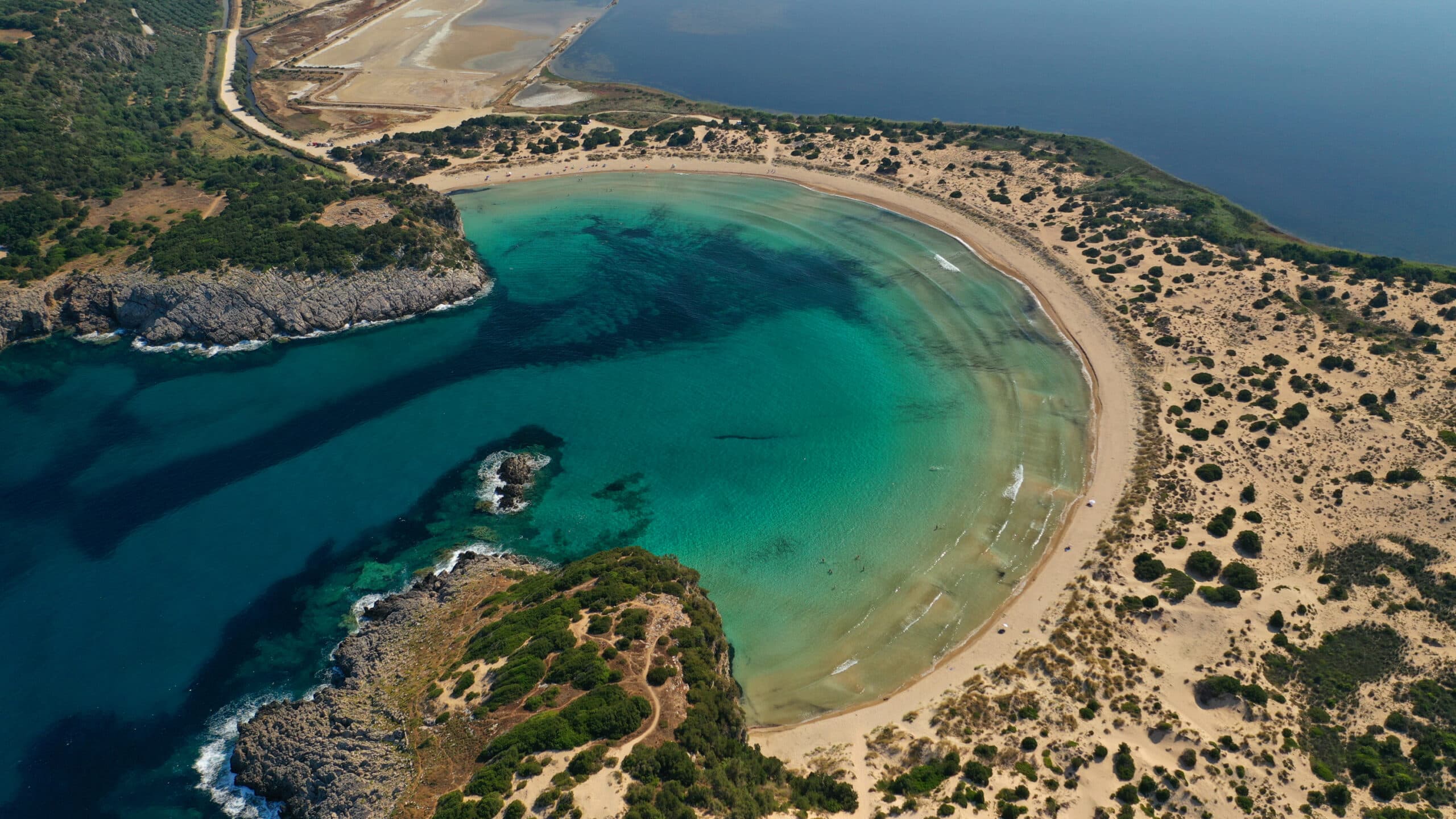
The Peloponnese’s soft southwest — olive groves to the horizon, a 40-kilometre arc of bay, and the country’s best-loved beach hidden behind a dune.
Messinia is the western finger of the southern Peloponnese — a soft, generous prefecture of olive groves, river valleys, long beaches and four medieval castles guarding the same bay. Its capital, Kalamata, is a working seaside city; its hinterland is some of the most fertile land in Greece.
The Mani sits to its east; Olympia and the Ionian to the north. Between them, Messinia keeps its own pace. The Bay of Navarino is the largest natural harbour in the Mediterranean, and Voidokilia at its northern tip — a perfect crescent of white sand behind a dune — is the single most photographed beach in Greece. Inland, the river valleys of the Pamisos and the Neda run through olive groves of Koroneiki trees, the variety that gives Kalamata oil its peppery finish.
Hover the map or the list — they're linked. Numbered roughly the way you'd drive them.
A 4th-century BC walled city, less visited than Olympia and arguably more atmospheric — a stadium, a theatre, an arcadian valley.
A chain of fifteen waterfall pools in a green gorge above Charavgi village. A two-hour walk to the highest fall.
Methoni’s twin on the eastern side of the peninsula — a hilltop castle, a working harbour, and miles of olive grove walks.
A vast Venetian sea-castle ringed on three sides by water, with a long sandy beach and a tiny old town tucked behind it.
A horseshoe bay, an Ottoman castle (Niokastro), and the navy memorial to the 1827 Battle of Navarino in a small white town.
A perfect horseshoe of white sand behind a dune system, looking out at the lagoon of Gialova. Walked into; never driven.
A working port city of 70,000, with a long seaside promenade, an old town climbing up to a Frankish castle, and the best Sunday market in the south.
Four luxury hotels on the dunes north of Pylos, two championship golf courses, and direct access to Voidokilia.
Three trips that draw on Messinia's long arc — one slow, one active, one for families.
Eight days in Messinia and the Mani during koroneiki harvest — mills, long lunches, village tables.
A point-to-point traverse of Mount Taygetos — Byzantine Mystras, the E4 ridge, a night at the new refuge, then down to Kardamyli.
Five open-water swim stages along the southern Peloponnese — Pylos, Methoni, Kitries, Kardamyli, Stoupa.
Seven days of e-MTB riding from Arcadian peaks to the Ionian coast — Menalon, Lousios, Taygetos, Voidokilia.
Eight days paddling the west Peloponnese — Venetian forts, sea caves, three nights camped on the sand.
Hike, kayak, cycle, SUP and canyon through Messinia — one Kalamata base, no repacking.
Olive groves carpeted in poppies and chamomile. Mild days, cool nights. Voidokilia near-empty.
Sea reaches 22°C by late May. Long evenings, the Kalamata bougainvillea in flower. Best month for the inland walks.
Hot, dry, busy. Voidokilia at sunrise; tavernas till midnight. Costa Navarino at peak; Kalamata empties for the islands.
Sea still 24°C in September. October brings the olive harvest and the first soft rains — the prefecture turns green again.
The harvest runs Oct–Dec. Mills in every village run day and night. A dozen year-round hotels stay open; everything else closes.
Messinia produces some of the most respected olive oil in the world. The Koroneiki variety, small and intensely peppery, accounts for nearly all production; the larger, dark Kalamata table olive is the prefecture’s second face. The harvest runs October to December, when every village mill works around the clock and the air smells of crushed leaves and warm wood.
The 40-kilometre crescent from Pylos to Voidokilia has been a strategic anchorage since the Bronze Age. Pylos’ Niokastro, an Ottoman fortress, looks across at the small island of Sphacteria, where Athens defeated Sparta in 425 BC, and into a bay where in 1827 the combined British, French and Russian fleets ended the Greek War of Independence. The bay is now part of a Natura 2000 site; the lagoon at Gialova is the second most important wetland in Greece.
The Kalamatianos is the most-danced folk dance in Greece — a 7/8 syrtos in twelve steps, danced in a circle, leader at the front holding a handkerchief. It takes its name from Kalamata, where it was first notated and where its modern form took shape. You will hear it at every village panigyri, every wedding, every Easter Sunday in the Peloponnese; it has been an Olympic anthem and a film soundtrack. Below it sits an older tradition of Maniot rebetiko from Kalamata’s port, and the lyric distichs sung at olive harvests.
Messinian cooking is the cooking of a generous land — olives, citrus, river-valley wheat, goat from the foothills. The pace is slow; the portions are not.
The almond-shaped, dark-purple olive cured in red-wine vinegar and brine. PDO since 1996; only olives grown in Messinia can carry the name.
The peppery, grassy, low-acidity oil pressed from Messinia’s small Koroneiki olive. Most farms here press their own; the freshest comes in November.
Long fried strips of unsweetened dough. Eaten with honey and walnuts in Trifylia, with hard cheese and olives along the coast.
Small thumb-pressed shells of egg pasta, made in mountain villages above Kalamata. Boiled and tossed with brown butter and grated mizithra.
A dense cake of sun-dried figs, almonds and aniseed, pressed into a round and aged a few weeks. End of every meal in Methoni and Koroni.
Crisp, citrus-edged Moschofilero from the Arcadian foothills inland; soft Roditis whites from the Trifylia coast. Both drink well at lunch.
What to expect in each — Messinia & Kalamata has a more idiosyncratic set of stays than most places in Greece.
Four sister hotels on the dunes north of Pylos. Two championship golf courses, beach access, full-service. The Westin and Romanos are the family options; W and Mandarin Oriental more design-led.
A handful of 12–30-room properties between Pylos and Methoni. Often olive-grove settings, swimming pools, a serious in-house restaurant.
Five or six rooms above an old kafenion. Common in Koroni, Kardamyli, the inland villages around Polylimnio. Breakfast in a courtyard.
Stone-built farmhouses in olive groves, modernist villas above Voidokilia. Best for groups and families in shoulder season; nearly all have pools.
Kalamata airport (KLX) has direct seasonal flights from London, Munich, Vienna, Zurich, Paris and a dozen other European cities. Athens is 2½ hours by motorway via the new E65 / Tripoli road.
A car is right almost everywhere. The coastal road from Kalamata to Methoni is fast and well-paved; the mountain villages above Polylimnio are 20-minute hairpins from the bay. Costa Navarino runs a free shuttle within the resort estate.
April–June and September–October for warm weather without the crowd. October–December for the olive harvest. July and August are beautiful but Costa Navarino prices peak.
Sun protection that means it. Walking shoes for Polylimnio and Ancient Messene. A windproof for the headlands at Methoni and Pylos. Swimwear stays in the bag from May to October.
Costa Navarino books a year out for August. Boutique hotels in Pylos and Koroni go three months ahead for May / September. Kalamata is easier to walk into. Tavernas don’t take reservations.
A sheltered bay in the south-west Peloponnese that has quietly become one of the most considered coastlines in the Mediterranean — without losing its Messinian bones.
Voidokilia, Methoni, Kyparissia — and the habit of being on the water before the wind changes.
Early-harvest, estate blend, and something spicy. What to look for, what to avoid.
Tell us a little about the trip you want — pace, who's coming, how you'd like to spend your mornings. We'll build the days.