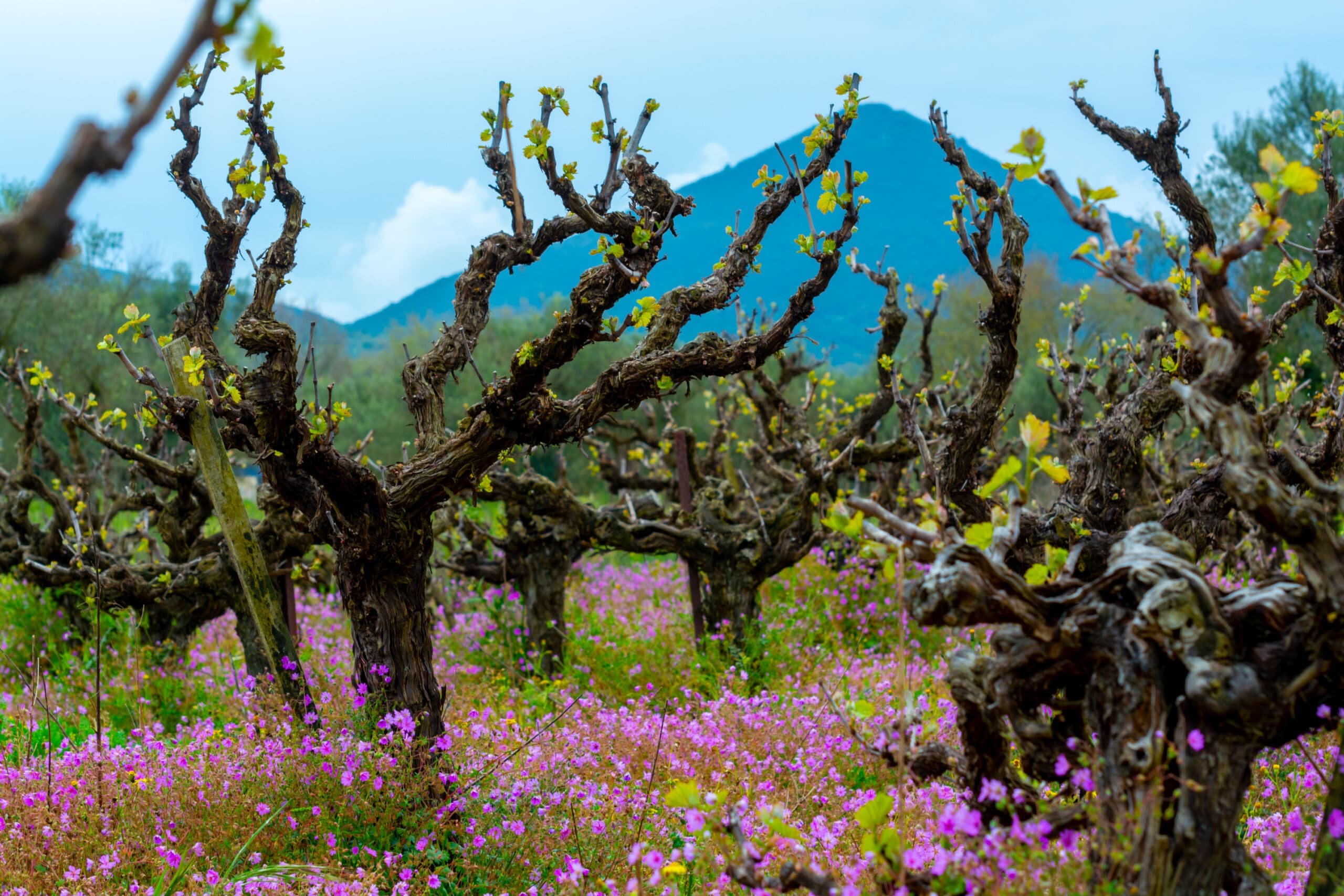
The doorway from Athens. Greece’s densest red-wine country, four major ancient sites within an hour, the canal that cuts the Peloponnese off from the mainland.
Corinthia is the northeastern shoulder of the Peloponnese — the prefecture you cross to enter the rest of it. The Corinth Canal cuts it from the mainland; behind the canal, a high inland plateau rises to Nemea, the densest red-wine region in Greece, and the four-thousand-year ancient sites that line the old road south.
The traveller’s Corinthia has two centres. The first is the Nemea valley: forty-odd serious wineries on a chalky, well-drained plateau at 250–700 metres, growing Agiorgitiko — the supple, plummy red the Greeks call “the blood of Hercules”. The second is the line of ancient sites: Acrocorinth’s great fortress, the agora of Ancient Corinth, the temple and stadium of Nemea, the Heraion of Perachora on its windswept cape. The two halves are an hour apart by car, and most considered visits do a slow week of both.
Hover the map or the list — they're linked. Numbered roughly the way you'd drive them.
A high mountain lake at 800 metres on the southern slope of Mount Helmos — the monastery of Saint George, fir-forested walks, the village of Goura, and the start of the Helmos cog railway.
A working agricultural village above an open archaeological site — a Hellenistic theatre, a long stoa, a Roman bath, and absolutely no tour buses. The most underrated site in the Peloponnese.
A 19th-century thermal spa town on the Saronic with a long pebble promenade, working hot springs, the Geraneia hills behind, and the easiest base for a winery weekend from Athens.
The headland west of Loutraki, with a 7th-century BC sanctuary of Hera at its tip — a small Doric temple, a sacred pool, a lighthouse, and a Saronic sunset that is a small religious experience.
The sanctuary of Zeus and the original Nemean Games stadium — a stone start-line still in place, the runners’ tunnel, three columns of the temple standing alone on the Argive plain.
The 6.3-km cut through the limestone isthmus that Nero began and the French engineers finished in 1893 — a thin slot of vivid blue water 80 metres below the road bridge. Stop, walk, drive on.
The 575-metre rock above Ancient Corinth, fortified continuously from the Mycenaeans to the Ottomans — the greatest fortress in southern Greece, with a view that takes in three seas.
The agora of one of the great Greek and Roman cities — the Temple of Apollo, the Pirene fountain, the bema where Saint Paul stood trial. Walked in two hours; the museum is excellent.
The densest red-wine country in Greece — 40 wineries on a chalky plateau between 250 and 700 metres, growing Agiorgitiko. Most open for tasting; the best have restaurants and a few rooms.
Almond blossom in the Nemea valley; the vines just budding. Sites empty, weather variable but kind. Acrocorinth at its greenest.
The vines fully out; long evenings on winery terraces; sea swimmable at Loutraki by mid-June. Ancient Corinth in its best afternoon light.
Hot and dry on the plateau — the early Agiorgitiko harvest begins late August. Coast and Loutraki busy; sites best at first light or 5pm.
The peak month — the harvest is in full swing, wineries open all hours, the air full of fermenting fruit. Our favourite Corinthian month, and most travellers’.
The new vintage in tank; tastings by appointment, fewer crowds, snow on the Geraneia some weeks. Loutraki is a winter spa weekend; Nemea is asleep but welcoming.
The Nemea PDO is the densest red-wine country in Greece — forty-odd serious estates on a chalky, well-drained plateau between 250 and 700 metres, almost all growing the indigenous Agiorgitiko grape. Plummy, supple, lower in tannin than its Mediterranean peers, it has been called “the blood of Hercules” since the Greek myths placed the slaying of the Nemean lion in this valley. Modern Nemea is divided into three altitude bands — valley floor, mid-slope, high vineyards — each producing a different shoulder of the same grape. The best estates open for unhurried tasting; several have restaurants worth the drive on their own.
Corinthia holds an unusual density of ancient places. Acrocorinth, on its 575-metre rock, was fortified continuously from the Mycenaeans to the Ottomans — a vast walled summit with three gates, an upper acropolis, and a view across the canal to the mainland and south to the Argolic gulf. Below it, Ancient Corinth was one of the great cities of the Hellenistic and Roman worlds: the agora, the Temple of Apollo, the bema where Saint Paul addressed the Corinthians. Forty minutes south, the sanctuary at Nemea still has three columns of its Doric temple standing, and the original 4th-century BC stadium with the runners’ tunnel and start-line cut into the bedrock.
Nero began it; the French engineers Lavalley and Eiffel’s nephew finished it in 1893; the Corinth Canal is the 6.3-kilometre cut through the isthmus that engineered the Peloponnese into an island. From the road bridge above the canal, you look 80 metres straight down at a thin slot of vivid blue water with a small boat in it. It is the moment you cross from the rest of Greece into the south. Most travellers stop, walk to the rail, look down for a quarter of an hour, and drive on — which is the right thing to do. The bungee operator, for the few who want it, is straightforward and well-run.
Corinthian cooking is the cooking of a wine country — long lunches, slow lamb, roasted vegetables, hard mountain cheese, citrus from the coastal plain. The food is a frame for the wine; in Nemea, the wine is the conversation.
The signature grape of Nemea — plummy, supple, medium-tannin, ageing well into a darker, leathered shoulder. The Greek answer to a serious modern Sangiovese; on every Peloponnesian wine list.
The traditional sweetbread of the Corinthian raisin trade — dense, dark, packed with sultanas and walnuts. Eaten in slices with coffee at any village kafeneio.
The small dark currant that gave Corinthia its export economy from the 16th to the 20th century — still grown on the coastal plain and the Vocha hills. Sweet, intense, the working ancestor of the modern raisin.
Lamb shoulder slow-roasted in paper or clay with mountain herbs, garlic, lemon and potatoes — the Sunday-lunch dish at every winery restaurant in the Nemea valley.
Whole fruit preserved in heavy syrup — Vocha citrus, sour cherries, walnut, fig. Served on a tiny plate with a glass of cold water in every village house in Corinthia.
Distilled from the grape marc each November — in Corinthia called souma in some villages, tsipouro in others. Drunk neat after long winery lunches; expect to be offered some.
What to expect in each — Corinthia & Nemea has a more idiosyncratic set of stays than most places in Greece.
A handful of Nemea wineries (Lafkioti, Palivos, Domaine Skouras-adjacent) operate a few rooms or restored stone houses on the estate. Vines outside the window; tasting on the doorstep.
Mid-size 30–80-room properties on the Saronic in Loutraki and Vrahati — thermal spas, sea-front, easy weekending from Athens. The discreet Greek weekend.
Five or six small stone-built guesthouses in the highland village of Trikala-Korinthias and around Lake Feneos — woodstoves, walks from the door, no spa pretensions.
A growing scene of restored stone farmhouses on the Vocha plain and around Vlachernes, with citrus orchards, working olive presses, and easy access to all four ancient sites.
Most travellers fly into Athens (ATH) and drive 1–1½ hours over the Corinth Canal. Corinthia is the closest Peloponnesian prefecture to Athens — a long weekend works comfortably from Athens without flights, and many Athenians day-trip the wineries.
A car is essential for the wineries and inland sites. Loutraki and Ancient Corinth are connected by suburban rail and frequent bus from Athens. Wineries are 5–20 minutes apart on slow valley roads; allow longer at harvest.
May–June and September–November. The September–October harvest is the headline experience, but a visit then must be booked early. Winter (Nov–Feb) is excellent for slow tastings and a quiet Acrocorinth.
Closed shoes for the steep paths of Acrocorinth and Sikyon. A driver, or a taxi-by-the-day arrangement, if you intend to do a serious tasting day in Nemea — spitting is one option, designated drivers another.
Winery tastings are increasingly by appointment, especially Nov–April; we book everything ahead. Loutraki spa hotels fill on weekends. Ancient Corinth and Acrocorinth do not need pre-booking; Acrocorinth has limited shade in summer — go early.
Tell us a little about the trip you want — pace, who's coming, how you'd like to spend your mornings. We'll build the days.