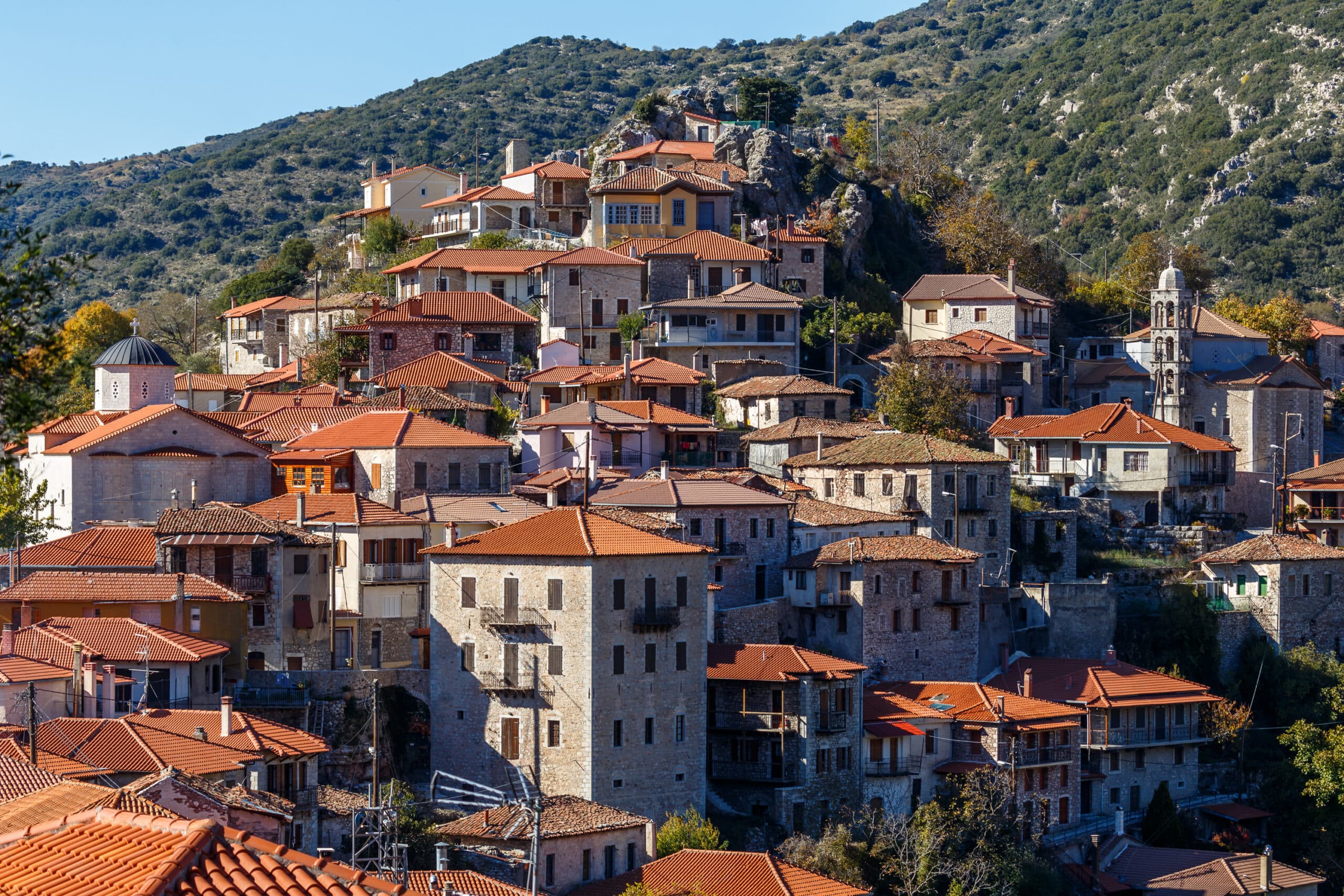
The mythic interior — stone villages on the Menalon, monasteries cut into the cliffs of the Lousios gorge, plane-tree squares with woodsmoke and tsipouro. The Peloponnese at altitude.
Arcadia is the only land-locked prefecture of the Peloponnese — a high inland country of plane-tree squares, stone villages on the slopes of the Menalon and Mainalon ranges, and the deep gorge of the river Lousios where four still-working monasteries hang off the cliffs.
The traveller’s Arcadia is the cluster of stone villages on the western Menalon — Dimitsana, Stemnitsa, Karytaina, Vytina, Langadia — and the Lousios gorge below them. The villages were built in the 17th and 18th centuries from local schist; their squares are paved in slate, their houses roofed in heavy stone slabs. In winter the Menalon takes snow and the woodstoves run from October to April; in summer the squares fill with cool air at 1,000 metres while the coast bakes. This is the Peloponnese the Greeks come to in November.
Hover the map or the list — they're linked. Numbered roughly the way you'd drive them.
A village built vertically into the side of a steep ravine above the river Lousios — home of the Arcadian master-mason guilds, whose stonework is in nearly every village in the prefecture.
The working agricultural capital of Arcadia, on a 650-metre plateau — a transit town for most travellers, but with an excellent archaeological museum and the best meat market in the Peloponnese.
The high agricultural valley south of Tripoli, with the ancient temple of Athena Alea and the Moschofilero vineyards of the Mantineia plateau — a white-wine country at 650 metres.
A 75-kilometre certified European long trail linking eight stone villages along the spine of the Menalon range. Eight days end-to-end, or any of the eight day-stages alone.
A higher, leafier village in a fir-forested basin on the Menalon — the weekend mountain town of Athens, with stone hotels, walnut sweets in every window, and snow most years from December to February.
A medieval village clinging to a steep ridge above the Alfeios river, crowned by a 13th-century Frankish castle — Byron’s favourite Peloponnesian view, and once on the back of the 5,000-drachma note.
A 15-kilometre limestone canyon with four working monasteries cut into its cliffs. The river the ancients said Zeus was bathed in. Walked end-to-end in two days on the Menalon Trail.
Dimitsana’s sister village, ten minutes away — a silversmithing tradition that runs back to the Ottoman period, a school of fine metalwork, and the trailhead to the Prodromos monastery.
A 17th-century mountain village on a balcony above the Lousios gorge — stone houses, the open-air water-power museum, and the most considered restaurant scene in the Arcadian highlands.
Three trips that draw on the stone villages, the gorge below them and the snow above.
Seven days of e-MTB riding from Arcadian peaks to the Ionian coast — Menalon, Lousios, Taygetos, Voidokilia.
Six days hiking the 75km Menalon Trail through Arcadia's stone villages and Lousios gorge.
Snow leaves the upper Menalon. The Lousios gorge runs at full force; the trail is muddy and dramatic. Villages quiet, woodstoves still on.
The high months for the Menalon Trail. Long evenings on the Dimitsana balcony, fir forests cool, kafeneia tables outside again. Sea below at 22°C.
Coast bakes; Arcadia at 1,000 metres stays in the high twenties. Vytina and Dimitsana fill with Athenian families. The villages have their summer festivals.
The Mainalon firs turn; walnut harvest in Karytaina; chestnut roasts in Langadia. The most photogenic Arcadia, our favourite month for the Lousios.
The Athenian winter weekend country — woodstoves, tsipouro, snow most years above 1,200m. Vytina, Dimitsana and Stemnitsa busy Friday–Sunday; midweek empty and beautiful.
The cluster of stone villages on the western Menalon — Dimitsana, Stemnitsa, Karytaina, Vytina, Langadia — was built largely in the 17th and 18th centuries by guilds of itinerant master-masons from Langadia, who carried their craft across the Balkans. The houses are schist, the roofs heavy slate slabs, the squares paved in flagstone. Stemnitsa has a 1,000-year silversmithing tradition and a school still teaching it; Dimitsana ran the gunpowder industry of the 1821 Revolution from the watermills in its gorge. These are working villages, not museums — the kafeneia have always been the centre, and still are.
The river Lousios drops fifteen kilometres through a deep limestone canyon between Dimitsana and Karytaina. Four still-working Byzantine monasteries hang off its cliffs — Prodromos, built into a 300-metre rockface, is the most dramatic; Philosophou is the oldest, with a hidden 10th-century cave chapel; Aimyalon and Old Philosophou sit on the eastern wall. You walk between them on the Menalon Trail. Inside, monks still serve loukoumi and a small glass of cold water; the silence is several hundred years deep.
For most of Greece, summer is the season; for Arcadia it is winter. From late October the woodstoves come on, the kafeneia move inside, and the Athenian families arrive on Friday afternoon. The winter table is mountain food — hilopites pasta with rooster, lamb yiouvetsi, goat stews, wild greens, sheep cheese aged in skins. Tsipouro at midday is normal. Snow falls reliably above 1,200 metres from December to February. This is the Peloponnese the Greeks come to when the rest of Greece feels too bright.
Arcadian cooking is high-altitude pastoral cooking: hilopites, slow lamb, mountain greens, walnut and honey, tsipouro at midday. The food is built for cold weather and long walks, and tastes best in November.
A small square egg-and-milk pasta, cut by hand, dried on linen, simmered slowly with rooster, lamb or kid. The Sunday lunch dish of every Arcadian village from Vytina to Karytaina.
A fermented cracked-wheat-and-yoghurt grain, dried into pebbles, simmered into a thick winter soup. Eaten with feta crumbled in. The Arcadian shepherd’s breakfast.
Whole young walnuts in heavy syrup, the spoon-sweet of Vytina — served on a tiny plate with a glass of cold water. Every village shop has a row of them in glass jars.
Hard sheep cheeses aged in skins from the Menalon shepherds — sharper, harder and more pungent than feta, eaten with walnut bread and a glass of red.
The signature white of the Peloponnesian highlands — dry, citrus, faintly floral, grown at 650 metres on the Mantineia plateau south of Tripoli. Tsantali, Troupis, Bosinakis are the houses to know.
Distilled from grape marc each November in copper stills behind the houses. Drunk neat at midday with mezedes; a small glass with the morning coffee is normal.
What to expect in each — Arcadia has a more idiosyncratic set of stays than most places in Greece.
Twenty-odd properties built into the schist houses of Dimitsana, Stemnitsa and Vytina. Wood floors, vaulted stone, working fireplaces, a balcony over the gorge or square.
A handful of 20–40-room hotels in the fir-forested basin around Vytina — spa rooms, indoor pools, the Athenian-family weekend in winter. More polished and less intimate.
Half a dozen tiny inns inside the medieval village of Karytaina, with views over the Alfeios valley to the Frankish castle. Three or four rooms each, breakfast at the kafeneio.
Modest village rooms (3–6 per inn) along the certified Menalon Trail — Lagkadia, Elati, Magouliana, Nymfasia. Designed for walkers; luggage transfer between them is easy.
Most travellers fly into Athens (ATH) and drive 2½–3 hours via the Tripoli motorway. Tripoli to Dimitsana is a slow, beautiful 70 minutes through the firs of the Menalon. There is no airport in Arcadia; Kalamata (KLX) is 1½ hours from the western villages.
A car is essential. The five western villages (Dimitsana, Stemnitsa, Karytaina, Vytina, Langadia) are 20–40 minutes apart on slow mountain roads; allow longer in winter. Petrol between villages is sparse — fill up in Tripoli or Megalopoli.
Walking weather May–June and September–October. Winter (Nov–Feb) for the woodstove villages, snow and hilopites — a different, slower kind of trip. Summer is cool and crowded with Athenian families; book the villages 6 weeks ahead.
Walking shoes for the Menalon Trail and the Lousios gorge. A warm layer year-round — villages are at 950–1,150 metres and evenings are cool even in July. In winter, proper boots and a serious jacket: snow above 1,200m is reliable.
Stone houses in Dimitsana and Stemnitsa book six weeks out for weekends in October–February (the Athenian winter weekend). Midweek, midsummer and shoulder season are easier. Vytina sells out for any snowy weekend.
Tell us a little about the trip you want — pace, who's coming, how you'd like to spend your mornings. We'll build the days.