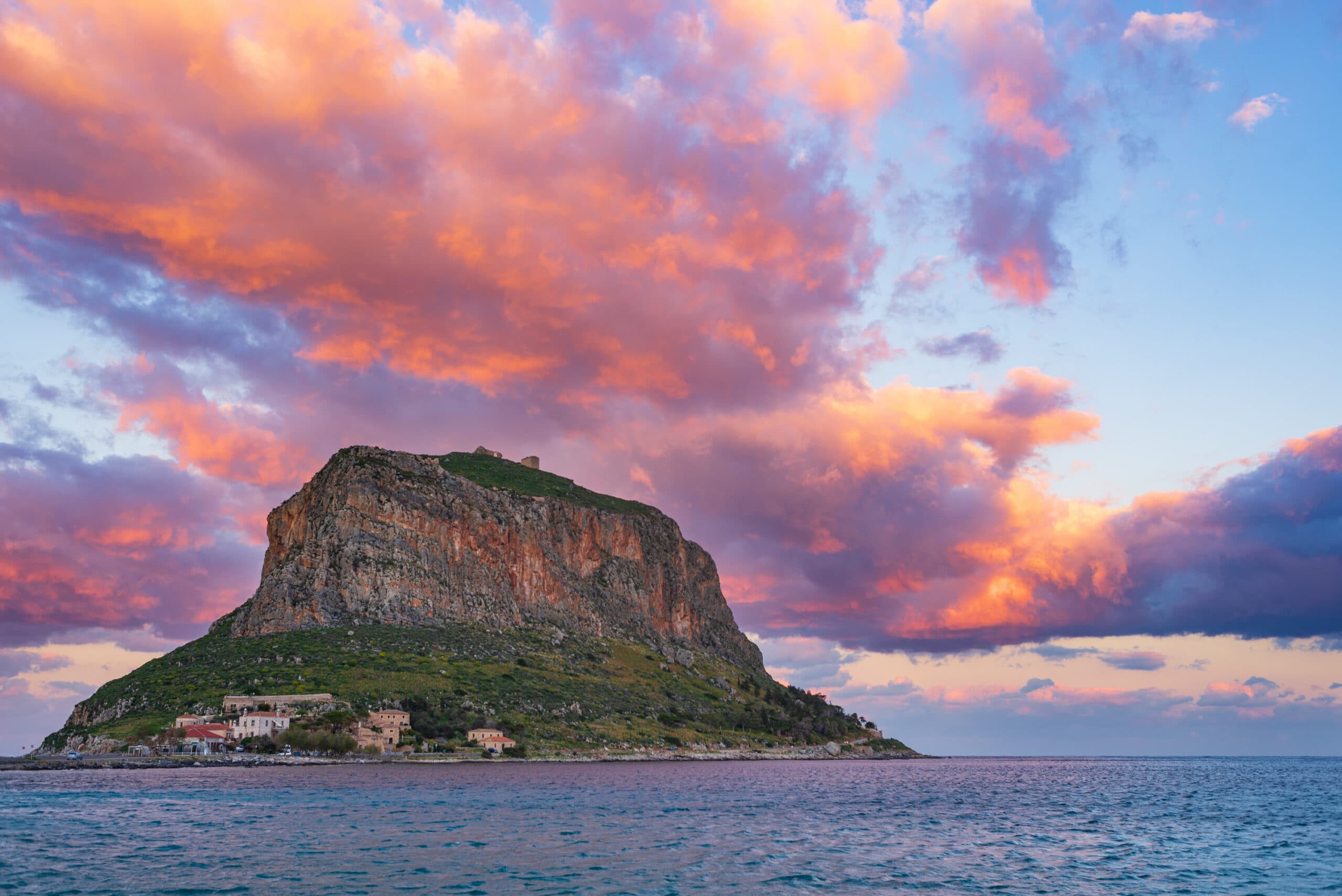
The eastern shadow of the Taygetos — Mystras, Sparta, the rock of Monemvasia. A long valley of mulberry trees, two seas, and three of the most haunted places in Greece.
Laconia is the southeastern finger of the Peloponnese — Sparta’s old territory, the Eurotas valley running south between the Taygetos and Parnonas ranges, opening onto two seas at the bottom of the country.
The valley itself is mulberry, citrus and olive country, with the modern town of Sparti at its centre and the ghost-city of Mystras on the hill above. To the east, the Parnonas drops to the Aegean; to the south, the long peninsula of Vatika ends at Monemvasia — a Byzantine town carved into a sea-rock — and Cape Maleas, where the Myrtoan and Laconian seas meet. Off the cape, the small island of Elafonisos holds Greece’s most copied beach.
Hover the map or the list — they're linked. Numbered roughly the way you'd drive them.
The eastern slope of the Taygetos rises straight from the Eurotas valley to 2,407 m — mountain villages, monasteries, the Mystras refuge hike to Profitis Ilias.
A medieval Frankish castle and a Byzantine ghost-village above the eastern Eurotas — like a smaller, quieter Mystras with no tour buses.
A village in a green amphitheatre on the Parnonas coast — limestone cliffs, climbing routes, deep-water swimming and three small tavernas. The Mediterranean before tourism.
The dramatic southeastern tip of the Peloponnese — a treeless headland where two seas meet. A working monastery, a lighthouse, and a four-hour walking trail down to it.
A small island five minutes off the coast, holding Simos — a 3-kilometre arc of white sand and turquoise water that has appeared on every Greek tourism poster.
The ancient port of Sparta — a horseshoe of red-tile fishermen’s houses, a tiny island reached by a causeway, and the best fish tavernas south of Nafplio.
The modern town below ancient Sparta — a working agricultural centre, an excellent archaeological museum, and the gateway to Mystras and the Taygetos.
The hill-city of the late Byzantines, abandoned in 1830 — ghost streets, frescoed chapels, the Despot’s Palace looking down over the Eurotas valley.
A medieval town carved into the side of a 350-metre sea-rock, reached by a single causeway. Two churches, a Venetian fortress at the summit, and one of the great walks in Greece.
Three weeks built around the valley, the rock and the two seas at the bottom of the country.
A point-to-point traverse of Mount Taygetos — Byzantine Mystras, the E4 ridge, a night at the new refuge, then down to Kardamyli.
Seven days of e-MTB riding from Arcadian peaks to the Ionian coast — Menalon, Lousios, Taygetos, Voidokilia.
The Eurotas valley turns green; orchids on the Parnonas slopes. Mystras at its quietest. Sea still cold.
Best month for Kyparissi and the Taygetos. Sea reaches 22°C by mid-June. Long evenings on the Monemvasia walls.
Hot inland; cooler on the southeastern coast. Elafonisos at its most crowded; the eastern coves stay quieter. Festivals in Sparta and Gythio.
Sea still 24°C in September. October opens the olive harvest in the Eurotas; the citrus turns colour late in the month.
Citrus harvest in the valley; first snow on the Taygetos peaks. A handful of Monemvasia hotels stay open; Kyparissi and Elafonisos largely close.
For two centuries (1262–1460) Mystras was the cultural and intellectual centre of a shrinking Byzantine empire. The philosopher Plethon taught here; some of the most refined late-Byzantine fresco cycles in the world line the chapels of the Pantanassa, the Perivleptos and the Metropolis. Walking the abandoned upper city, with the Eurotas valley below, is the closest you can come to time-travel in mainland Greece.
A 350-metre sea-rock connected to the mainland by a single causeway (the name means “single entrance”), Monemvasia was a Byzantine fortified town from the 6th century, then Venetian, then Ottoman, then Greek. The lower town — 30 streets of stone houses, two cathedrals and a square — has been continuously inhabited for 1,400 years. Above it, the upper town is open ruin and wildflowers, with the Hagia Sophia chapel still standing on the cliff edge.
The Eurotas valley between the Taygetos and Parnonas is a working agricultural place — oranges, lemons, mulberries (the silk industry of the 19th century), olives, the modern Sparta of football clubs and farm cooperatives. The villages of Sklavochori, Anavryti, Mystras village hold a particular Laconian quality: small squares with plane trees, kafeneia run by the same family for four generations, an honest disinterest in being looked at.
Laconian cooking is the cooking of a long valley: citrus, mulberry, olive, mountain herbs. The food is unfussy and depends on what came in that morning from the gardens above Sparta or the boats at Gythio.
Thin sheets of dough rolled, fried, dipped in hot honey and walnut. The wedding sweet of the Eurotas valley; sold by weight at every village bakery.
Chicken cooked slowly with feta, kalamata olives and small white onions; a Sunday lunch dish from the Bardouniotes villages of the Taygetos foothills.
A semi-hard sheep’s cheese matured in brine in long strips (“sfeles”), made only in Laconia and Messinia. Sharp, salty, perfect grilled.
The Eurotas valley grows some of the most prized oranges in Greece — mostly Valencia and Navelina. Markets in Sparta in January–March; juice on every cafe table.
Monemvasia gave its name to Malvasia — the medieval sweet wine the Venetians shipped from here. Modern producers in Sklavochori are reviving it as a serious dry wine.
The Taygetos villages distil tsipouro from grape marc each November. Drunk neat with mezedes; a small glass with coffee in the morning is not unusual.
What to expect in each — Laconia & Monemvasia has a more idiosyncratic set of stays than most places in Greece.
A dozen properties built into the medieval houses of the lower town. Stone vaulted rooms, sea-facing terraces, no cars. The most atmospheric stays in southern Greece.
Restored stone farmhouses on olive and citrus estates around Mystras and the Eurotas. Half a dozen rooms, a working mill, breakfast from the garden.
A handful of 12–20-room properties: Plytra and Archangelos on the southern coast, Kyparissi on the eastern. Most have private beach access.
Stone-built guesthouses in Anavryti, Polydroso, Kosmas. Five or six rooms, a wood stove in winter, walking from the door.
Most travellers fly into Athens (ATH) and drive 3½–4 hours via Tripoli. Kalamata (KLX) is closer for the southern coast (2 hours to Monemvasia, 1½ to Gythio) and is the smarter choice for combining Laconia with the Mani.
A car is essential. The valley spine and the southern coast roads are fast; the eastern Parnonas coast (to Kyparissi) is slow and beautiful; the Taygetos villages are 30-minute hairpins. Allow 2 hours Mystras→Monemvasia.
May–June and September–October. Mystras is hot in midsummer; the Monemvasia walls glow in October light. Kyparissi works April–October; Elafonisos June–September.
Walking shoes for Mystras and the upper Monemvasia. Swim shoes for the southern coves. Layers for the Taygetos in shoulder season. A torch for the Monemvasia lanes after the day-trippers leave.
Hotels inside the rock book six months out for May, September, October. Kyparissi has only thirty rooms in total. Mystras has plenty of options in nearby Sparti or in Mystras village. Tavernas don’t take reservations.
Four routes, three seasons, and the refuge huts nobody tells you about.
A slow afternoon in the ghost city of the late Byzantines — with a pocket list of the chapels worth the detour.
Two crossings from Neapoli — one in May, one in November. Notes for the unprepared.
Tell us a little about the trip you want — pace, who's coming, how you'd like to spend your mornings. We'll build the days.