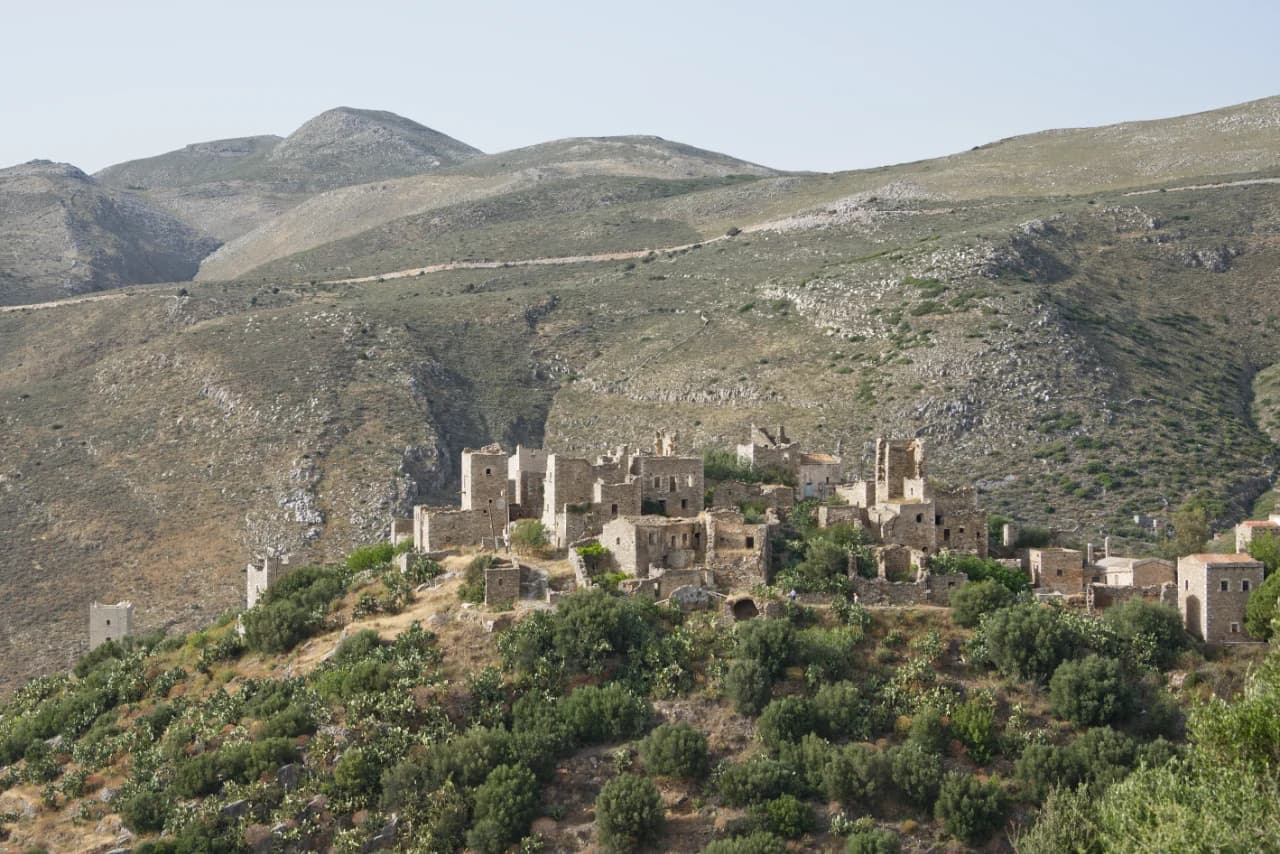
The middle finger of the Peloponnese — stone, cypress, stubborn sea. A landscape of tower-houses and feast-day tables that has kept its own counsel for six hundred years.
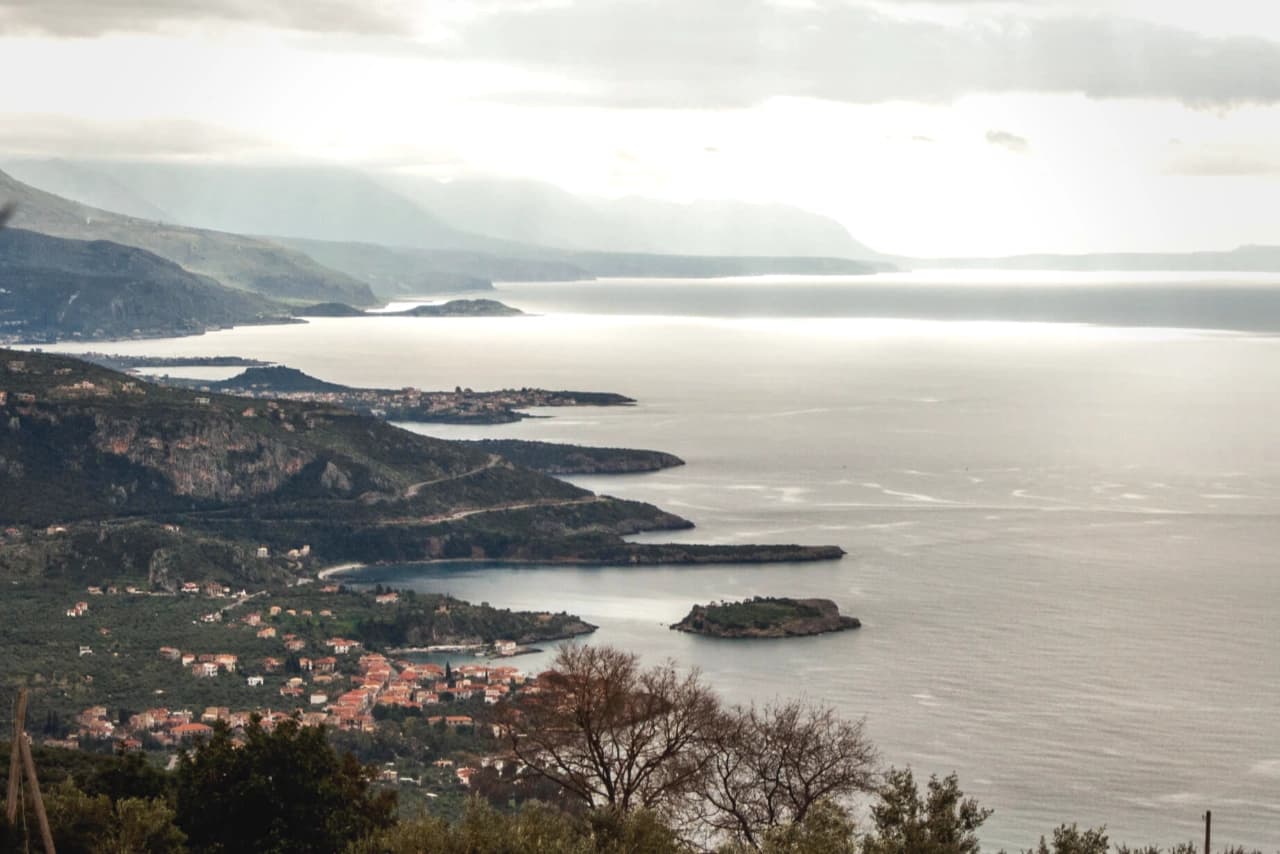
The Mani is the middle of three peninsulas at the southern end of the Peloponnese, and the wildest. Mountains fall straight into sea. Villages of stone towers crowd on a slope. The light is unforgiving and the food is unflinching.
The Outer Mani, around Kardamyli and Stoupa, is greener — olive terraces, cypress, the Taygetos shedding into the Messinian Gulf. The Deep Mani, south of Areopoli, is the dramatic one — treeless rock, salt wind, the tower-villages of Vathia and Gerolimenas perched over a sea that was once famous for pirates. At the tip is Cape Tainaron, where Homer said the entrance to the underworld was.
Hover the map or the list — they're linked. Numbered roughly the way you'd drive them.
The southernmost point of continental Greece. A thirty-minute walk to a lighthouse, over the supposed entrance to the underworld.
A single-street fishing village on a cove that feels like the edge of the map. Two good hotels, one perfect sunset.
A river-carved cave system three kilometres long, entered by wooden rowboat. Stalactites the colour of honey and bone.
A turquoise fjord below Areopoli — the old Mavromichalis family port. Swim off the rocks, eat at a table that almost touches the water.
The Mani’s unofficial capital, where the revolution against the Ottomans began in 1821. A square of stone, a cathedral with swords carved above the door.
A harbour village in a tight cove — eight tavernas, one church, the best grilled fish on the peninsula.
Two soft bays side-by-side, an old expat artists’ colony around Kazantzakis’ summer cottage. Families, swimmers, long lunches.
Patrick Leigh Fermor’s village — stone houses in cypress groves, a quiet sea, the best inherited taverna culture in Greece.
A kayak at Kardamyli, a gorge hike, an olive harvest morning, a tower-village driving day.
Three considered itineraries that use the Mani as their backbone.
Eight days in Messinia and the Mani during koroneiki harvest — mills, long lunches, village tables.
A point-to-point traverse of Mount Taygetos — Byzantine Mystras, the E4 ridge, a night at the new refuge, then down to Kardamyli.
Five open-water swim stages along the southern Peloponnese — Pylos, Methoni, Kitries, Kardamyli, Stoupa.
Seven days of e-MTB riding from Arcadian peaks to the Ionian coast — Menalon, Lousios, Taygetos, Voidokilia.
A 100km sea kayak expedition down the Mani — fishing villages, sea caves, three nights under canvas.
A 6-day ride from Kalamata down the wild west coast of the Mani, through stone villages most travellers never see.
The peninsula turns green for six weeks. Anemones, poppies, asphodel. Empty tavernas, cold swimming.
Warm days, cool evenings. The Viros Gorge and Mount Profitis Ilias are at their best. Sea is 22°C by mid-June.
Hot and bright. Swimming everywhere; tavernas stay open past midnight. Inland villages above 700m stay cool.
Sea still 24°C, light turning golden, crowds gone. October brings the olive harvest and the first rain.
Many places close. A handful of year-round guesthouses stay open. Rain, empty beaches, spectacular skies.
For six centuries the Mani was a law unto itself — Ottoman-occupied on paper, feuding clan-country in practice. Families built tower-houses, four or five storeys of undressed stone, with the ground floor for animals and the top for shooting from. Vathia, the most famous, still holds thirty of them on a single ridge. Gerolimenas hotel is a restored one; so is a growing number of guesthouses in Areopoli and Kardamyli.
Maniot food is the food of a dry place. Syglino (pork smoked over sage and cypress), lalangia (fried dough strips for breakfast), hilopites (egg noodles cut by hand), wild greens boiled with lemon, and a preserve of orange peel and walnut that shows up at the end of every meal with Greek coffee. The wine is dark and serious — dry reds from Sparta, a few coastal whites.
The Mani keeps a thick calendar of saints’ days, each with its own village feast (panigyri) — long tables in a square, a violin and a lute, lamb on coals. The most famous is the feast of Taxiarches above Diros in early November. Maniot mourning songs (moirologia) are one of the oldest continuous musical traditions in Greece; recordings survive from the 1950s.
The Mani eats seriously. What grows here is stubborn — olives, oranges, figs, mountain herbs — and the cooking preserves, smokes, cures. A meal is long; the best ones last the afternoon.
Pork belly cured with salt, orange peel and sage, then cold-smoked over cypress. Served thin-sliced with bread and a cold shot of souma (grape marc).
Long strips of unsweetened dough fried in olive oil. Eaten for breakfast with honey and hard cheese, or at feast days with syglino.
Egg-and-milk noodles cut in tiny squares. Boiled in rooster broth, served with crumbled goat cheese.
Orange peel or green walnut preserved in syrup, served on a cold plate with Greek coffee and a glass of water. Ritual.
The Mani’s eastern slopes produce some of the most peppery Koroneiki in Messinia — look for mills at Proastio and Chora.
Agiorgitiko and Mandilaria from the Eurotas valley, inland. Small producers; bring a bottle back from the Laconian side.
What to expect in each — The Mani has a more idiosyncratic set of stays than most places in Greece.
Four or five rooms in a 200-year-old stone tower. Thick walls, cool stone floors, a small pool in what was once the threshing yard. Most in Deep Mani.
A dozen or so between Kardamyli and Gerolimenas. Twelve to thirty rooms; usually a restaurant worth eating at; all have sea access.
The Mani’s backbone. Half a dozen rooms above a taverna, breakfast in the kitchen, a grandmother who knows every walking path.
Stone villas in olive groves above Stoupa, modernist concrete above Limeni. Best for groups and families in shoulder season.
Kalamata (KLX) is the closest airport — 45 minutes to Kardamyli, 90 to Areopoli. Athens is 3½ hours by road via the new E65 motorway.
A car is essential. Roads are good along the coast, narrow and slow over the Taygetos. Budget extra time; the bends are part of the Mani.
April–June and September–October. July and August are beautiful but hot; many Maniots themselves leave for the mountain villages.
Walking shoes. A light jumper — evenings are cool even in summer. Swim shoes for rocky coves. Cash for villages inland.
Tower-house hotels and the few Gerolimenas rooms book up months ahead for shoulder season. Kardamyli is easier. Tavernas don’t take reservations.
Seven minutes in, ten minutes out. Notes from a summer of early starts.
The Mani's smoked pork: brine, fire, orange peel, patience. A recipe only half the villages agree on.
Four routes, three seasons, and the refuge huts nobody tells you about.
Tell us a little about the trip you want — pace, who's coming, how you'd like to spend your mornings. We'll build the days.