A long bay of olive silver and Aegean blue on the west coast of the Peloponnese — quietly stewarded, softly inhabited, and arguably Europe’s most considered seaside.
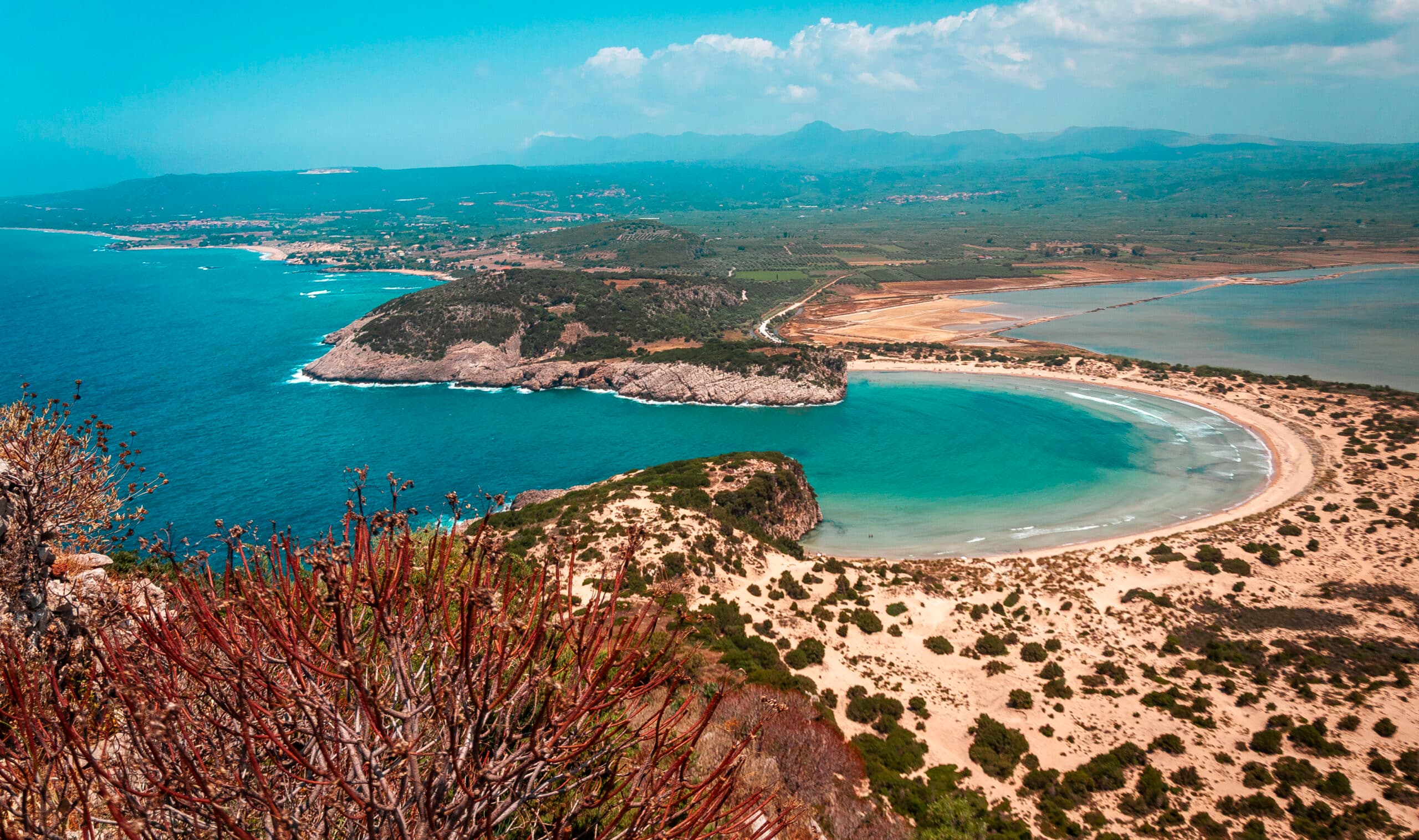
On the west coast of the Peloponnese, where the mountains ease their shoulders toward the sea, Costa Navarino is less a resort than a landscape under careful stewardship — four thousand hectares of olive groves, cypress and soft coastal pine around the horseshoe bay of Pylos.
Ancient Nestor walked these hills; Venetian merchants watched their ships from the castle battlements; today it is two considered hotels, five championship courses, and a stretch of coast kept carefully — almost monastically — wild. The nearest town is Pylos, a three-sided square above a Venetian harbour; the nearest beach is Voidokilia, a perfect semicircle that appears on every list of the most beautiful in Europe.
Considered itineraries that use Costa Navarino as a waypoint or a week.
A gentle September Tuesday, drawn from how the regulars here actually spend one. Distances are short; the sea is warm until October; the light at both ends of the day is the reason people come back.
The lagoon road opens at first light. Park at the northern end, walk through the reeds; the bay is still glass. Twenty minutes of water, a towel, and the drive back past pink flamingos in the Gialova lagoon.
Three cafés under the plane trees on Plateia Trion Navarchon. Order Greek coffee, a bougatsa, and watch the fishing boats clear the inner harbour. The 1827 monument sits in the middle like a piece of furniture.
Fifteen minutes inland. The best-preserved Mycenaean throne room in Greece, under a light canopy; Linear B tablets that survived because the palace burned down. Bring water — there is no shade at the site itself.
Grilled bream at a taverna with its tables on the sand. Start with gogges, taramasalata, and a small carafe of the house white. Finish with watermelon that arrives without being ordered.
The sea-fortress at the end of the causeway. Walk the curtain wall — it takes an hour if you stop — and finish at the Bourtzi tower on its own islet. The stone turns gold an hour before sunset.
Back to the resort for dinner at Barbouni, or a last table at an olive-grove taverna in Romanos. The coast road between Petrochori and the bay is worth the longer way around after dark — almost no cars, the Bay lit only by the moon.
Costa Navarino sits on the long arc between Voidokilia and Pylos. Everything worth seeing is within forty minutes — listed roughly south to north.
A perfect semicircle of pale sand, ringed by dunes. Homer's "sandy Pylos" — reached through a lagoon.
The best-preserved Mycenaean palace in Greece. The Linear B tablets were found in its archives.
A three-sided square above a Venetian harbour; the 1827 Battle of Navarino ended Ottoman rule at sea.
A sea-fortress on an islet, linked by a stone causeway. Walk the curtain wall at golden hour.
Fifteen minutes inland — jade pools and a short scramble between oaks.
Long reads and good maps — stories that live in this landscape.
No list of thirty items. Just the twelve that matter — and the one thing you'll wish you'd left at home.
A sheltered bay in the south-west Peloponnese that has quietly become one of the most considered coastlines in the Mediterranean — without losing its Messinian bones.
A slow afternoon in the ghost city of the late Byzantines — with a pocket list of the chapels worth the detour.
Tell us a little about the trip you want — pace, who's coming, how you'd like to spend your mornings. We'll build the days.