A nine-kilometre sand beach backed by an umbrella-pine forest and the Strofylia wetland — one of the longest sand beaches in Greece, lightly developed, inside the Kotychi–Strofylia National Park.
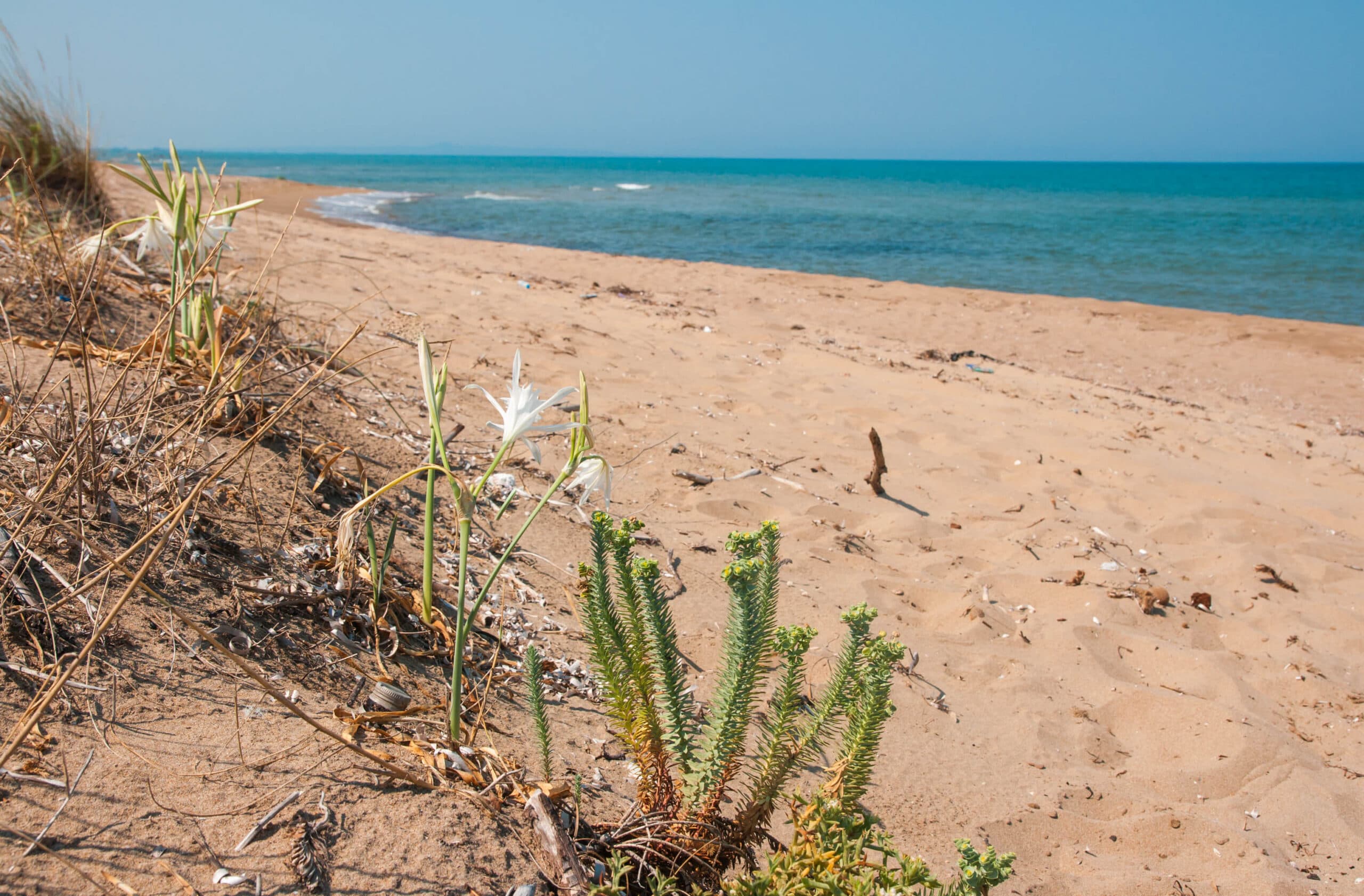
Kalogria is a NATURA-protected coastal strip: nine kilometres of sand, 2,200 hectares of umbrella-pine forest behind, and the Strofylia–Kotychi wetland — a Ramsar site since 1975.
The northern end of the beach is the developed end (a hotel, beach bars, parking). The southern half has nothing on it but sand and pine. Herons, egrets and coots winter in the lagoons, flamingos have been seen here in winter, and the water shelves gently, which is why families come.
A late-September day on the south beach, when the water is still warm and the parking is empty.
Five minutes east of the village, a gravel turn-off from the Araxos–Manolada road leads to the park’s eco-centre on the bank: small timber houses and a lookout tower. Herons, coots, grebes and cormorants, depending on the season; migrant waders pass in autumn.
Ten minutes south by car to the old oak on the Araxos–Manolada road, start of the park’s H6 trail: 2.9 km through the stone pines, past the Kentros canal and over a wooden bridge to the sea.
Where the path meets the beach, about 3 km south of the village: sand and dunes, away from the organised northern beach. Bring water and shade.
Back along the path and ten minutes by car to the eastern edge of the village: a family taverna for grilled bream, lamb chops and tzatziki.
From the shrine on the Araxos–Kalogria road by the chapel of Agios Petros, a steep track climbs about 20 minutes to a wooden lookout below the Panagia chapel: the lagoon, the forest and the whole beach below.
Back down to the sand. The beach faces west over the Ionian; the sun sets around 19:25 in late September.
The interesting things sit along one coastal strip: two lagoons, the pine forest and 15 km of sand. Most are a few minutes apart by car, and best seen on foot.
Nine kilometres of sand backed by dunes and the pine forest. The northern part has the hotel, an organised beach, beach bars and parking, and the largest dune in the Peloponnese at its north edge. The quiet southern stretch is reached through the forest.
A shallow lagoon of about 150 ha, 0.5 to 1.5 m deep, between the Mavra Vouna hills and the Lamia marsh. The park’s eco-centre and lookout tower stand on its bank; herons, coots, grebes and cormorants, depending on the season.
The largest lagoon in the Peloponnese, about 750 ha, north of Lechaina in Elis, still fished with traditional fish traps. The park reaches it from the village of Areti; a lookout tower stands at the start of its cycling route.
Fifteen minutes east: a village of 659 people (2021) with a long sandy beach that families like, and the Grecotel Casa Marron resort.
Forty-five minutes north-east: Greece’s third-largest city, with a castle above the old upper town and a restored Roman odeon used for summer performances.
Pyrgos, the capital of Elis, is an hour south by road; Olympia is an hour and a half. Detail on the Olympia page.
Tell us a little about the trip you want — pace, who's coming, how you'd like to spend your mornings. We'll build the days.