A 750-metre stone town in a basin below Mount Helmos — terminus of the Odontotos cog railway, gateway to the Helmos snow station, and the most considered base for the hidden wineries on the north slope.
Kalavryta is a stone town in a green basin below the Helmos, with the cog-railway pulling in at one end of the square and the road up to the ski station leaving at the other.
It is also the site of the Wehrmacht massacre of 13 December 1943, in which 696 men and boys were killed; the town carries that quietly. Above it, on the north slopes and the hills towards the coast, a handful of small wineries grow the rare red Mavro Kalavrytino. Below it, the Odontotos. Around it, a working mountain landscape that doesn’t need explaining.
A day in late September, when the air is sharp and the wineries are still open.
Montana Café faces the cathedral across the square. One of the cathedral’s clocks still shows 14:34, the moment the killing began on 13 December 1943.
The Municipal Museum of the Kalavrytan Holocaust opens at 09:00 in the old primary school, on the street up from the station. Five halls cover the town before the war, the occupation and 13 December 1943. From its forecourt a marked route with nine stands of testimonies climbs to Kapi hill, about 500 m east of the centre.
Ten minutes south-west by car. The museum keeps the banner of 1821, and the plane tree where, by tradition, Germanos raised it stands outside the gate.
Back in town: a family grill house since 1973, now run by the second generation. Spit-roast and grilled meats, and the house salad with armouzi, the local feta-and-yoghurt mix.
Twenty minutes north on the Diakopto road, the Mega Spilaio monastery’s old vineyard, replanted since 1999. A walk in the vines, the restored winery and its small cellar, then a guided tasting. Book the 14:00 start.
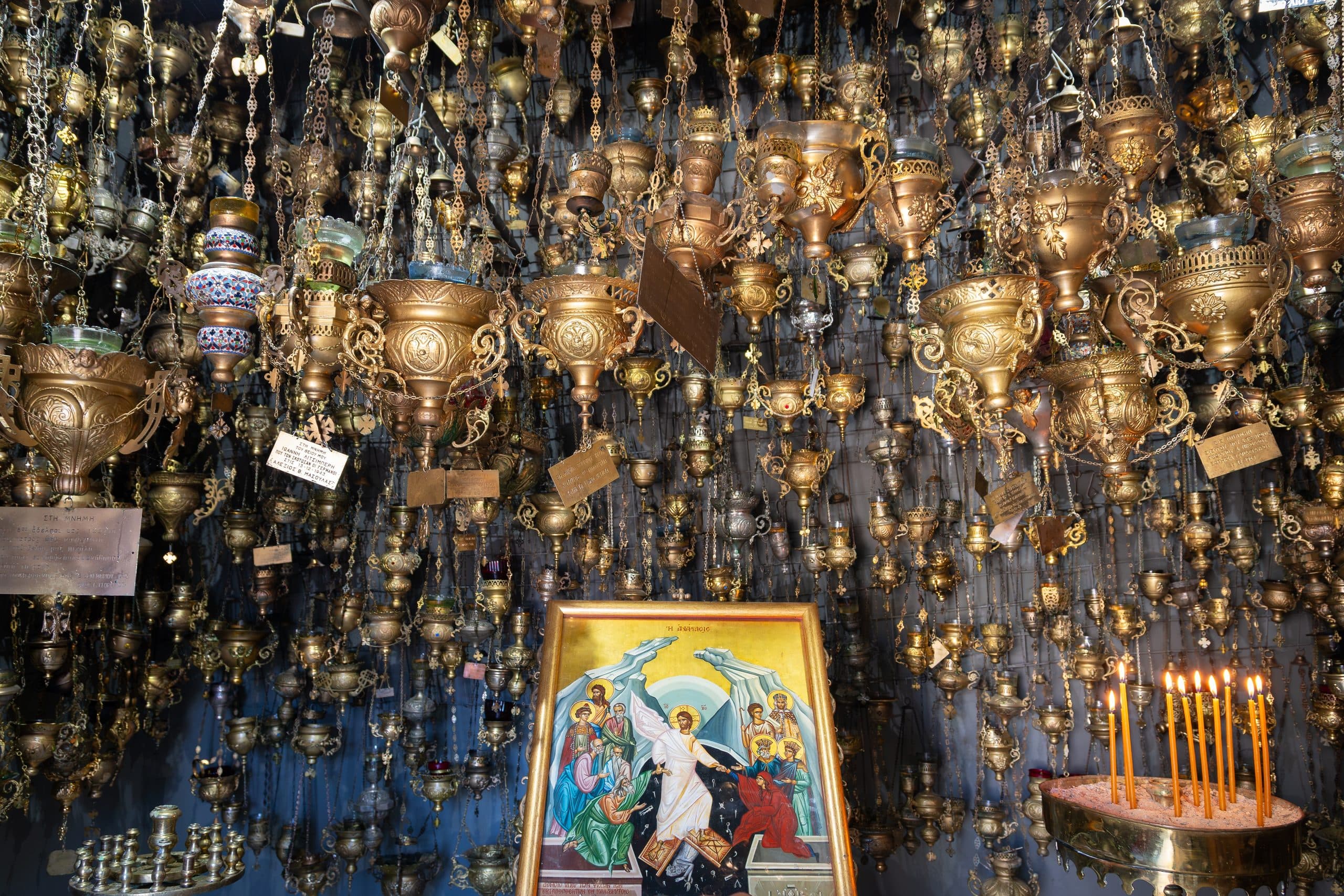
Five minutes up the road, built into a cliff about 120 m high and founded, by tradition, in 362 CE. The church keeps a wax-mastic icon of the Virgin attributed to St Luke; a small museum holds manuscripts and relics.
On the pedestrian street: slow-cooked dishes and grills, handmade pasta and a list of Greek wines only. Ask for the local afiri cheese.
The town is small. The interesting things are at the railway station, on the hill, on the road up, and on the north slope.
The small square at the top of the pedestrian street, around the old plane tree where, by tradition, Zaimis, Petmezas and Fotilas met before the 1821 Revolution. The resistance fighter Konstantinos Pavlopoulos was hanged from it in 1943. The listed Helmos Hotel building of 1922 stands at No. 1.
The upper terminus of the Odontotos, opened on 10 March 1896, at the lower edge of town; the market street climbs from opposite the station. Trains from Diakopto arrive at 10:59 and 13:24 and leave again at 11:04 and 13:37.
On Kapi hill, about 500 m east of the centre on the road to the ski centre: a white cross about 8 m tall, the names of the men executed on 13 December 1943, and Anna Vafia’s sculpture of the Petrified Mother. Every 13 December a procession walks up from the cathedral.
Ten minutes south-west: the monastery where, by tradition, the flag of the 1821 Revolution was raised on 25 March. Its museum keeps the banner, the vestments of Archbishop Germanos and a Gospel given by Catherine the Great; the plane tree stands outside the gate.
Twenty-five minutes south at Kastria: a river cave about 2 km long with 13 lakes; guided tours walk about 500 m of it. Closed Tuesdays; the last tour starts at 16:30 on weekdays and 17:30 at weekends.
Twenty-five minutes up the mountain road: seven lifts and 25 km of runs between 1,700 and 2,340 m. The 2025–26 season ran from 21 December to 19 April. Detail on the Helmos snow resort page.
Tell us a little about the trip you want — pace, who's coming, how you'd like to spend your mornings. We'll build the days.