A red-rock town under a 250-metre cliff on the eastern Parnonas — more than 2,600 sport-climbing routes, an aubergine festival, and the only place in Greece that still speaks Tsakonian.
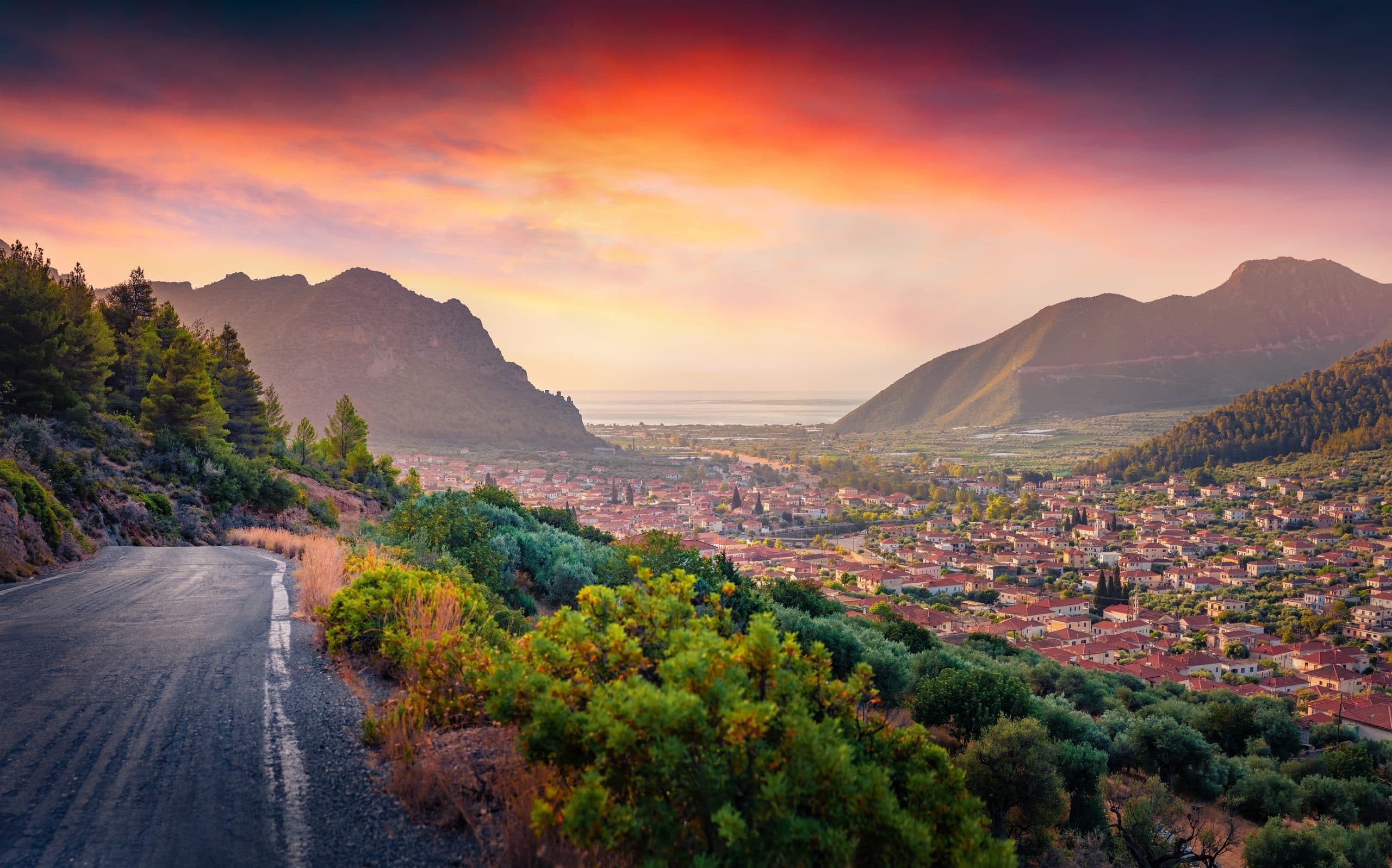
Leonidio sits in a wide green valley four kilometres inland from the eastern Argolic coast, dominated by the 250-metre red limestone cliff of Mount Parnonas rising directly behind the town.
In the last fifteen years, Leonidio has become one of the major sport-climbing destinations in Europe — over 2,600 bolted routes across 55 crags, on overhanging red and orange limestone, with grades from beginner 4a to project 9a. The climbing season is October to May; in summer the rock is too hot. The town beneath is a working agricultural centre of 4,000, surrounded by aubergine fields (the tsakoniki melitzana is the local DOP product). The Tsakonian language, a direct descendant of ancient Doric Greek and unintelligible to other Greeks, is still spoken by a dwindling, mostly elderly few — estimates run from a few hundred to a few thousand — the last linguistic remnant of pre-Slavic Greek. The seaside village is Plaka, four kilometres east — a sandy beach, a fishing harbour, and a half-dozen tavernas. Poulithra is the next bay south, quieter. The drive in from Nafplio is two hours along the dramatic Tsakonian coast — one of the great Peloponnese drives. Most visitors come either as climbers (October–May) or as travellers seeking the road less travelled (June–September). Two distinct seasons; both worth visiting.
A Leonidio day for non-climbers.
A Greek coffee at the central plateia in the shade of the red cliff overhead.
Forty-five minutes up the Dafnon gorge into the mountains; the road climbs through the gorge to the village at 1,150 m on the shoulder of Parnon.
Wander the stone village for an hour — the big plateia under its plane trees, the church of Agioi Anargyroi at its centre, the lanes behind.
The old taverna on the north side of the plateia, open since 1955 — braised lamb or rabbit, a wild-greens pie, half a litre of bulk red.
Slow descent back through the gorge, with the red cliff unfolding ahead.
An afternoon swim — the water deep clear, the cliff above pink in the late sun.
Taverna tou Psara — the fisherman's taverna in a stone house on the pebble beach since 1902; half a kilo of the owner's catch, the boats coming in.
Within an hour and a half.
Five minutes east — the seaside village with the beach. Fish tavernas, fishing harbour, a few small hotels.
Ten minutes south — a quieter beach village, smaller, slower. The alternative if Plaka is busy.
Forty-five minutes inland up the Dafnon gorge — the plane-tree plateia village at 1,150 m on Parnon; the mountain half of the day above.
An hour and twenty-five minutes by road to the north-west — the Tsakonian mountain village of chestnut trees and stone houses; a full day out, not a lunch run.
Thirty minutes north on the coast — a working fishing village, useful as a stop on the long drive in.
An hour and a quarter north — the market town of the inner Argolic coast, with its beach quarter Paralio Astros four kilometres away; the natural halfway stop on the Nafplio drive.
Tell us a little about the trip you want — pace, who's coming, how you'd like to spend your mornings. We'll build the days.