Greece’s first modern capital (1828–1834) and the prettiest old town in the Peloponnese — marble lanes, three fortresses, neoclassical mansions in faded ochre, and an evening volta on the seafront.
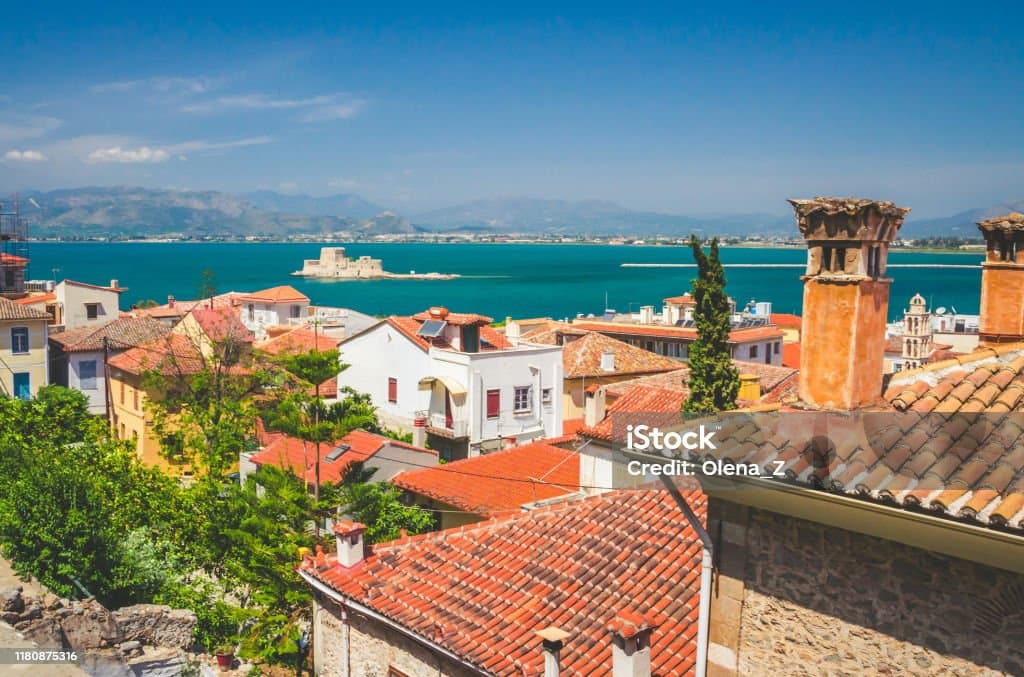
Nafplio sits on a small peninsula on the inner Argolic Gulf — three fortresses (Palamidi above, Akronafplia between, Bourtzi on a tiny island in the bay), a marble-paved old town of 18th-century Venetian and 19th-century neoclassical houses, and a long seafront promenade.
What separates Nafplio from a dozen other Greek old towns is completeness. Almost every house in the centre is a restoration; almost every shop is independent; almost every meal is good. The town held the Venetian function as a regional capital, then the Ottoman, then the Bavarian-Greek; King Otto’s first palace is here, the first Greek parliament met here, the first Greek bank opened here. Palamidi Fortress is the icon — 999 stone steps to the top, or a five-minute drive to the back gate. Bourtzi is the 15th-century sea-island fortress; Akronafplia is the lower citadel, now partly built over by a hotel. The shopping is unusual for Greece — three excellent bookshops, four jewellers using local stone, two of the better delis in the Peloponnese. The food is excellent across the board; the seafront has the standard tavernas, but the back-street ones (Aiolos, Mezedopolio Noulis) are better. Two nights minimum; three is right; with day-trips to Mycenae/Epidaurus/Tiryns, four works perfectly.
A three-day Nafplio base, two day-trips and one slow town day.
999 steps in the cool morning, brunch in the old town, slow afternoon at a quayside café. Acclimatise.
Five-minute boat to the sea-fortress at sunset; dinner at Karamanlidika or Aiolos; volta on the marble lanes after.
Out at 08:00, Mycenae 09:00–11:30, lunch at Mycenae village or back at Tiryns, Tiryns 14:00–15:00. Back in Nafplio for the late afternoon swim at Karathona.
Out at 08:00, Epidaurus theatre 09:00–10:30, drive south to a Kandia or Iria beach for lunch and a swim, back to Nafplio for the evening volta and dinner.
Within forty minutes.
Eight minutes north — Mycenae's smaller cousin. Detail on the Tiryns page.
Twenty-five minutes north — the Bronze-Age citadel of Agamemnon. Detail on the Mycenae page.
Thirty minutes east — the perfect 4th-century theatre. Detail on the Epidaurus page.
Fifteen minutes south — a sandy bay with hotels and beach tavernas. Detail on the Tolo page.
Twelve minutes north-west — the working agricultural town, oldest continuously-inhabited city in Europe. Detail on the Argos page.
Long reads and good maps — stories that live in this landscape.
Tell us a little about the trip you want — pace, who's coming, how you'd like to spend your mornings. We'll build the days.